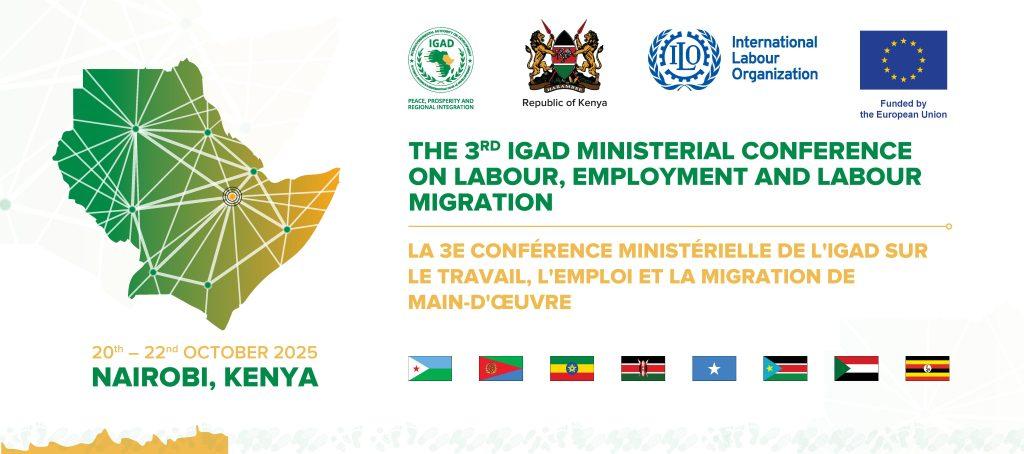
The Intergovernmental Authority of Development (IGAD) is one of the Regional Economic Communities (RECs) of the African Union (AU) comprising Djibouti, Eritrea, Ethiopia, Kenya, Somalia, South Sudan, Sudan and Uganda, thus forming a vast and complex region. The region also faces a wide range of socio- economic development challenges including forced migration and displacement, climate change, food insecurity, conflict, low levels of industrialization and trade, high levels of unemployment, poor infrastructure and unplanned, fast-growing urbanization.
While the region has experienced economic growth in recent years, with a 7 per cent increase in the gross domestic product (GDP) per capita between 2021 to 2022, this is yet to translate into creation of decent and productive jobs for the steadily growing population, approximately 60 per cent of whom are of working-age. The region has also recorded an increase in unemployment rate from 14.3 per cent to 15.9 per cent between 2012 and 2022 suggesting that labour markets continue to struggle to absorb the large number of new entrants to the labour force each year as result of population growth. The region has an estimated labour force participation rate at 69.5 per cent with high level of asymmetry based on gender with women’s labour participation remaining low. Further, the average gross domestic product (GDP) per capita was recorded at USD1,369 in 2022 with wide economic disparities within the region. Agriculture remains a key sector of the economies of the IGAD members states, employing more than 80 per cent of the population, despite the region being the most vulnerable region within the African continent to climatic variation. Lack of diversified economic base particularly reliance on subsistence agriculture, narrow private sector, mismatch between skill supply and demand and limited capacity of labour market institutions, among other things, put significant barriers to harness the potential of a young active labour force in the region.
The region is also characterized by mixed migration flows driven by a wide range of interrelated factors – socio-economic, political, and environmental – leading to complex migration patterns within and from the region. There has been steady increase in international migration, particularly of those of working age across the member states, from 3.6 million international migrants in 2012 to 7.5 million in 2022 with consistent growth in international migration of both men and women. As per the ILO estimates, the African continent recorded 14.3 million international migrants in the labour force as of 2022. The IGAD region is region of destination, transit and origin, particularly for migrant workers going to the Middle East. Limited option for regular migration remains a key challenge in the region, compelling migrants to opt for clandestine and irregular migration pathways, leaving them more vulnerable to abuse and exploitation. The Red Sea Route is a key pathway for irregular migrants from the Horn of Africa States, particularly from Somalia, Ethiopia, Eritrea and Djibouti to the Gulf States via Yemen with Saudi Arabia as the main destination, primarily seeking livelihood opportunities. With more than 60,000 migrants arriving in Yemen
in 2024 alone, the route has recorded more than 3,400 deaths and missing persons in the past decade.
In order to address these issues, IGAD has adopted several policy instruments and legal frameworks with the aim of strengthening governance of labour, employment and labour migration. Furthermore, IGAD has institutionalized platforms to advance regional coordination and collaboration to address the challenges of the labour market such as the IGAD Ministerial Committee on Labour, Employment and Labour Migration, IGAD Regional Consultative Process (RCP) and the Regional Migration Coordination Committee (RMCC).