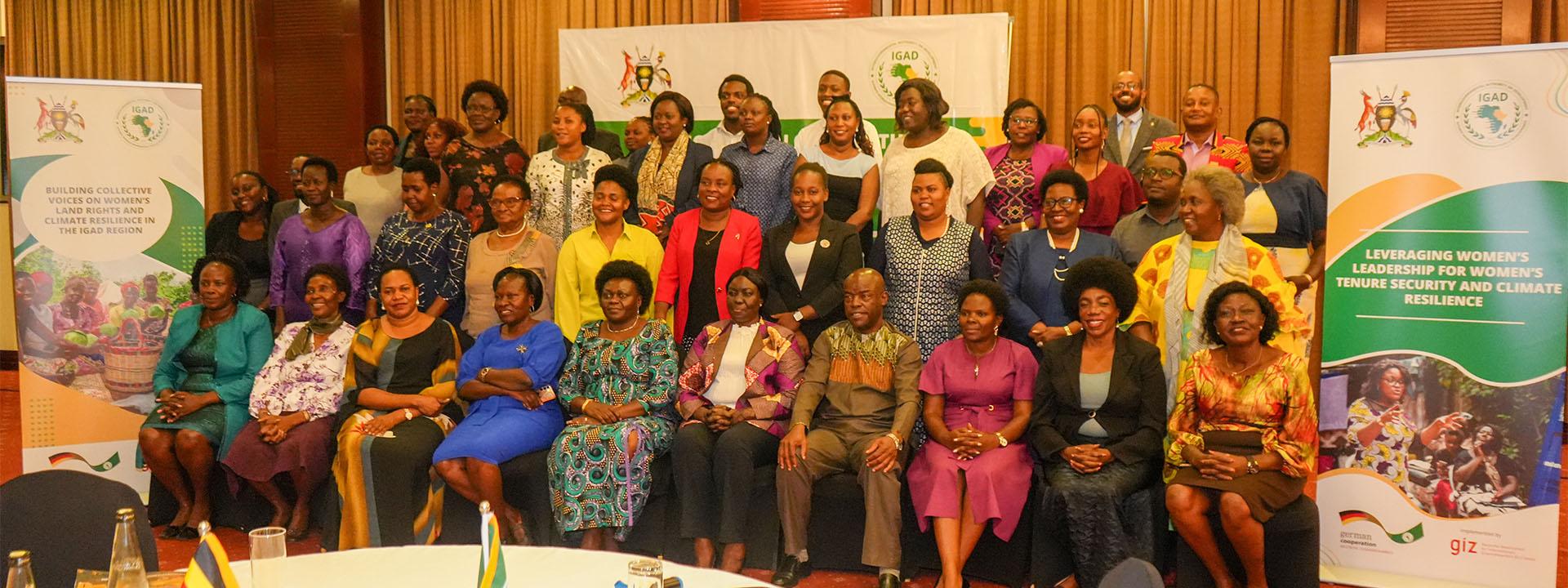
June 26, 2025 (Kampala, Uganda): The Intergovernmental Authority on Development (IGAD), through its Land Governance Programme, convened a high-level national dialogue with women parliamentarians in Uganda, aimed at advancing women’s leadership in land governance and climate resilience. The two-day forum, held in Kampala, brought together lawmakers, land experts, and key government stakeholders to drive gender-responsive policies and action.
The dialogue forms part of a broader IGAD regional initiative to equip women parliamentarians across its Member States with the skills and tools needed to influence laws, budgets, and policies at the intersection of gender, land rights, and climate change.
“As women leaders, we must be at the forefront of driving policies that secure land rights for women and protect our communities from the impacts of climate change,” said Hon. Sarah Opendi, Chairperson of the Uganda Women Parliamentary Association (UWOPA). “This is not just about fairness—it’s about survival, dignity, and sustainability.”
The forum comes at a critical time, as climate change continues to deepen gender inequalities—particularly in rural communities where women bear the greatest burden of climate impacts yet remain marginalised in land ownership and decision-making processes.
Throughout the discussions, participants explored the interconnectedness between gender, land governance, and climate resilience. They received practical training in gender analysis of sector budgets, a vital tool to ensure that national development plans, disaster risk reduction measures, and climate responses fully reflect women’s priorities and needs.
“Women remain the most disadvantaged when it comes to land rights and bear the greatest burden from climate change,” noted Naome Kabanda, Director of Land at the Ministry of Lands, Housing and Urban Development. “This dialogue is critical in helping us connect the dots between gender, land, and climate resilience—ensuring that women are not left behind in the policies and programmes that shape our nation’s future.”
A recurring message echoed across the sessions was that securing women’s land rights is not merely a gender issue but a foundation for climate resilience, food security, and sustainable development.
“Women’s secure land rights are fundamental—not only to gender equality but also to economic growth, climate resilience, and sustainable development,” emphasised Victoria Anib, IGAD’s Head of Social Development. “This dialogue is about ensuring that women parliamentarians are fully equipped to shape the laws, policies, and budgets that directly impact women’s rights, community resilience, and the region’s climate future.”
The dialogue delivered several key outcomes, including the development of six national and one regional policy brief on gender, land governance, and climate resilience. A significant achievement was the establishment of a Regional Women Parliamentarians Platform on Women’s Land Rights and Climate Resilience, designed to foster cross-border collaboration, knowledge sharing, and joint advocacy across IGAD Member States.
The meeting also adopted a concrete set of action plans aimed at advancing women’s rights and gender-responsive climate action. Among the priorities is the acceleration of the finalisation and adoption of Uganda’s National Gender and Climate Change Strategy, ensuring inclusive climate action and equitable resource allocation for women.
Participants further underscored the importance of strengthening gender-disaggregated data systems. They called on Ministries, Departments and Agencies (MDAs), along with local governments, to prioritise the generation, analysis, and use of gender data to inform more targeted, inclusive policies. The National Identification and Registration Authority (NIRA) was tasked with establishing a centralised data hub to support this critical effort.
The dialogue concluded with a resounding call for enhanced collaboration among parliamentarians, government institutions, and development partners. A joint roadmap was adopted, outlining strategic priorities including legislative reforms, public awareness campaigns, and accountability mechanisms to track progress in gender-responsive land governance and climate action.
This dialogue in Uganda is part of a wider series of national engagements held in Djibouti, Ethiopia, Kenya, Somalia, South Sudan, and Uganda—laying the groundwork for a regional convening scheduled for Nairobi in July 2025. Supported by GIZ, the initiative reinforces IGAD’s ongoing commitment to advancing gender equality, good governance, and climate resilience across the Horn of Africa.