Ministerial Communiqué
3rd IGAD MINISTERIAL CONFERENCE ON LABOUR, EMPLOYMENT AND LABOUR MIGRATION.
Theme: Improving Labour Migration and Mobility Governance for Prosperity in IGAD Region
PREAMBLE
We, the Ministers of Labour and Employment, and Ministers of Interior and Internal Security of the IGAD Member States:
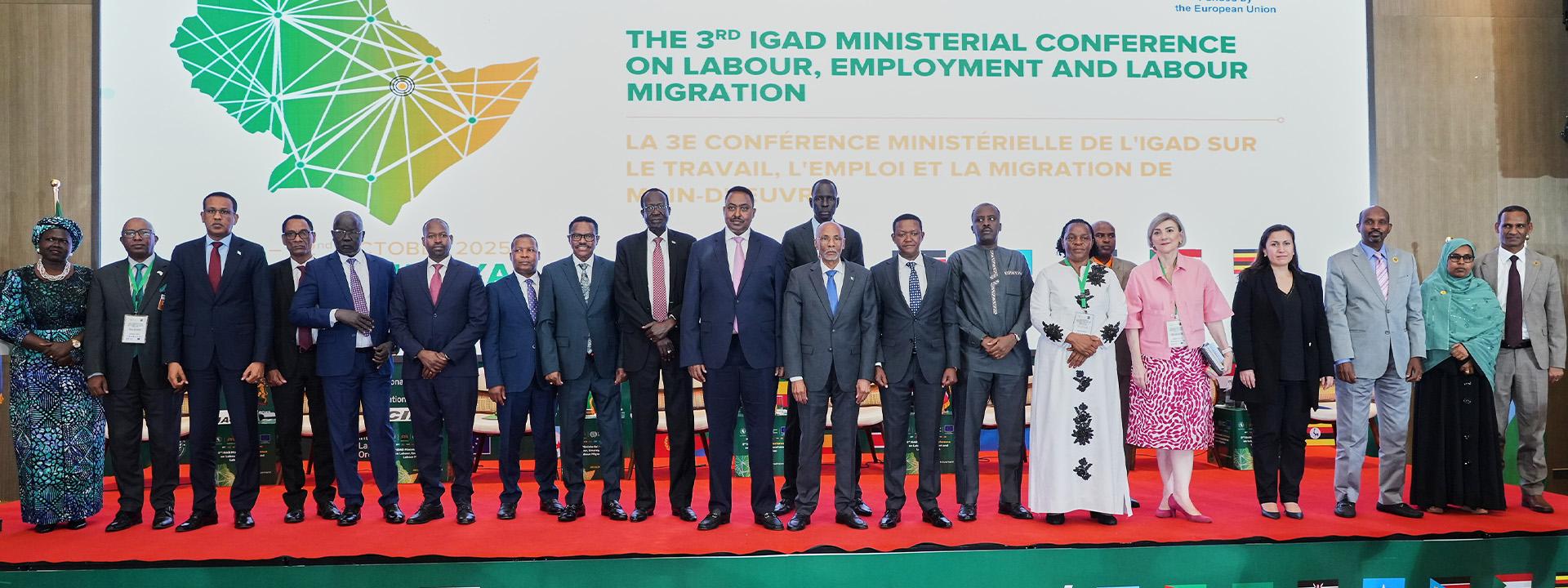
H.E Omar Abdi Said, Minister of Labour, Formalisation and Social Protection of the Government of Djibouti, Honorable James Hoth Mai, Minister of Labour of the Republic of South Sudan, Honorable General Mangar Buong Acok, Acting Minister, Ministry of Interior of the Republic of South Sudan, Ambassador Jibril Ibrahim Abdulle, Ambassador of Federal Republic of Somalia to the Republic of Kenya and Permanent Representative to the UN Office in Nairobi, Honorable Dr. Mutuuzo Peace Regis, Minister of State for Gender and Cultural Affairs of the Republic of Uganda, Honorable General David Muhoozi, Minister of State for Internal Affairs, Republic of Uganda, HE Solomon Soka, State Minister of the Ministry of Labour and Skills of the Federal Democratic Republic of Ethiopia and Honorable Dr. Alfred N. Mutua, Cabinet Secretary, Ministry of Labour and Social Protection, Republic of Kenya.
Meeting in Nairobi, Kenya, on this day, Wednesday 22 October 2025 for the 3rd IGAD Ministerial Conference on Labour, Employment and Labour Migration, presided over by H.E Omar Abdi Said of the Ministry of Labour, Formalization and Social Protection of the Republic of Djibouti and IGAD Chair;
In the presence of H.E Dr. Workneh Gebeyehu, the Executive Secretary of IGAD, HE Ambassador Mohammed Guyo, IGAD Special Envoy for the Red Sea, Gulf of Eden and Somalia (IGAD RESGAS) H.E Dr. Denisa Elena Ionete, the EU Ambassador to the Republic of Djibouti and IGAD; H.E Khumbula Ndaba, ILO Country Director for Ethiopia, Djibouti, Somalia, Sudan, South Sudan and Special Representative to the AU, IGAD and ECA, Ms Nihan Erdogan the IOM Deputy Regional Director for Operations East, Horn and Southern Africa.
Also, present were representatives of Development and Social Partners namely GIZ, The Confederation of IGAD Employers (CIE), The Horn of Africa Confederation of Trade Unions (HACTU), and International Trade Union Confederation-Africa (ITUC-Africa);
Recalling the provisions of Article 7(b) of the Agreement Establishing IGAD (1996) which enjoins IGAD Member States to harmonise their legal frameworks, policies and programmes on Free Movement of Persons in the IGAD Region;
And articles 9 and 10 of the 2021 IGAD Protocol on Free Movement of Persons on mobility of workers, which has so far been signed by the Republic of Sudan (2021), Republic of South Sudan (2021), the Federal Democratic Republic of Ethiopia (2022), the Democratic Republic of Somalia (2023), the Republic of Uganda (2024);
And the aspirations of the IGAD Djibouti Declaration on Labour, Employment and Labour Migration signed on 21 October 2021 and its Plan of Action;
Recognising the challenges of fragility and vulnerability which arise from conflict and political instability, poverty, high dependence on subsistence agriculture, adverse effects of climate change, informal economy, low productivity and unemployment particularly of the youth who constitute more than 60% of the population of IGAD;
Noting with concern that regional unemployment stands at 15.9 per cent, with youth unemployment reaching 28 per cent, while at least 1.5 million IGAD citizens work in Middle East and Gulf countries, many facing decent work deficits and exploitation;
Affirming the commitment of IGAD Member States to advance Decent Work and Social Justice through the ratification and implementation of International Human Rights Law, International Labour Standards, the ILO Declaration on Fundamental Principles and Rights at Work, and its Follow-up (1998), as amended in 2022 and the Centenary Declaration for the Future of Work (2019), the Abidjan Declaration on Advancing Social Justice (2019), the 2030 Agenda for Sustainable Development, AU Agenda 2063, the Global Compact for Safe, Orderly and Regular Migration, Protocol to Prevent, Suppress and Punish Trafficking in Persons Especially Women and Children (2000), supporting the UN Convention Against Transnational Organised Crime (2000) and the Doha Declaration on Labour Mobility between the Gulf Cooperation Council, Jordan, Lebanon and African States (May 2024) as a framework for enhanced inter-regional cooperation;
Affirming that human rights of all migrants, including migrant workers, regardless of their status, should be promoted and protected and that International Labour Standards apply to all workers, including migrant workers, irrespective of immigration status, unless otherwise stated;
Recognizing the limitations in implementation of legal and policy frameworks on labour migration governance and compliance with international labour standards, limited capacities of labour market institutions, nascent social dialogue, gender inequality and low social protection coverage, and the prevalence of fraudulent recruitment practices, trafficking in persons and smuggling of migrants as well as sever decent work deficits endured by migrant workers in countries of destination, including forced labour;
Deeply concerned about the irregular migration crisis Eastern Africa in particular in the Red Sea Route, which accounts for approximately 50% of all regional migratory movements characterized by human suffering of men, women and children, human trafficking, exploitation by smuggling networks, and protection gaps in countries of transit and destination, and the loss of over 4000 lives in the last decade;
Noting with concern, the dangerous journeys taken by migrants on this route are facilitated by human traffickers and smugglers through harsh desert treks, perilous sea crossings using overcrowded unseaworthy boats, the severe humanitarian needs faced by migrants taking this dangerous journey, driven by economic hardship, environmental degradation, unemployment, persistent poverty and conflict;
Appreciating the efforts of transit countries especially Governments of Djibouti and Somalia for their enforcement operations at desert land crossings and at Sea. These law enforcement operations target the dismantling of human trafficking and smuggling networks that subject migrants to physical and psychological abuse, extortion and forced returns;
Recognizing the importance of social dialogue as a cornerstone of good governance of labour and employment, as outlined in ILO Convention 144 on tripartite consultation and reaffirming the role of representative employers’ and workers organisations in the formulation, implementation and monitoring of labour migration polices and frameworks;
Appreciating the significance of social dialogue in fostering social and economic cohesion and the proactive efforts of CIE and HACTU to enhance fundamental labour rights and decent work for all;
Acknowledging the need to address the challenge faced by millions of IGAD citizens who lack legal identification or have IDs unsuitable for the digital age hampering the delivery of social services and the realization of the IGAD Protocol on Free Movement of Persons;
Welcoming the proposal for the IGAD Single Visa Initiative aimed at facilitating tourism, trade, and investment through harmonized visa systems for non-IGAD citizens;
Further recognising the progress made by IGAD Member States and Social Partners in the implementation of the Djibouti Declaration and its Plan of Action, through the Phase II of the Project on Support to Free Movement of Persons and Transhumance in the IGAD Region;
Having deliberated on the progress made since the Djibouti Declaration 2021, the new dynamics of labour migration in the IGAD Region and the East Africa-Middle East corridor, irregular migration crisis through the Red Sea Route, International Labour Standards, the proposed IGAD Single Visa Initiative for Non-IGAD citizens and the proposal for provision of interoperable IDs for IGAD citizens; taking into consideration the rapidly unfolding developments in Digital Space and Artificial Intelligence;
Do hereby adopt the following resolutions and commitments:
On the implementation of the Djibouti Declaration on Labour, Employment and labour migration and its Plan of Action:
Expedite the ratification and implementation of the IGAD Protocol on Free Move- ment of Persons and International Labour Standards, particularly the ILO Fundamental Conventions and relevant ILO conventions related to migrant workers.
Scale up compliance with ILO reporting obligations under articles 19 and 22 of the ILO Constitution through the timely submission of comprehensive reports, making full and effective use of supervisory mechanisms, particularly article 24 and article 26 on complaints, in order to enhance protection of men and women workers, regardless of their nationality and migration status.
Monitor working conditions, employment relations, skills needs, emerging legislative, policy and institutional reforms, and practices in countries of destination, within IGAD Region and the Gulf Cooperation Council (GCC) countries, Jordan and Lebanon to enhance protection of rights of migrant workers and support their access to decent working opportunities.
Accelerate the implementation and use of the IGAD Regional Guidelines on Rights- based Bilateral Labour Agreements (BLAs) in their drafting, negotiation, implementa- tion, monitoring and evaluation.
Expedite the development of a common regional position of IGAD Member States on key aspects of Bilateral Labour Agreements (BLAs) in line with International La- bour Standards.
Strengthen bipartite and tripartite social dialogue for improved labour, employment and labour migration governance in the IGAD Region and other key countries of des- tination.
Intensify operational measures in line with the ILO Fair Recruitment Initiative as well as the AU Fair and Ethical Recruitment Strategy (2024) to detect, identify and prevent abusive and fraudulent recruitment practices against migrant workers and pro- tect them from violence, harassment and practices that can lead to conditions amounting to forced labour.
Enhance efforts towards the extension of social protection to all workers, including migrant workers, those in rural areas and informal economy as well as those impacted by climate change.
Conclude bilateral and multi-lateral social security agreements for coordination and portability of social security rights and benefits among IGAD Member States and key countries of destination.
Provide migrant workers, including those in irregular situations with accessible and comprehensive protection services, including accurate information, access to jus- tice and effective remedies, and responsive consular services, that responds to specific vulnerabilities across migrant groups, gender and sectors, without discrimination.
Implement the IGAD Youth Skilling Initiative to create decent employment for youth on green jobs, manufacturing, digital and platform economy with full participation of youth in line with IGAD Youth Policy Framework.
Develop regional labour market information system and labour market observatory.
On addressing Irregular Migration in the Red Sea Route and other Routes:
xiii. Adopt a holistic Whole-of-Route, Whole-of-Society and Whole-of-Government approach in addressing migration flows, taking into account the entire spectrum of situations people find themselves in countries of origin, transit and destination;
xiv. Address the root causes of irregular migration by investing in livelihoods, job crea- tion, skills development, and climate resilience programs in communities of origin;
xv. Adress abysmal working conditions and conditions amounting to forced labour and modern day slavery in countries of destination within IGAD region as well as in the Gulf Cooperation Council countries, Jordan and Lebanon
xvi. Revitalize the peace, mediation and security processes in the region including strengthening maritime security;
xvii. Expand safe and regular migration pathways by creating a visa free IGAD Region, negotiating more bilateral and multilateral labor migration schemes in line with ILS, IGAD Regional Guidelines on Rights Based BLAs and with the engagement of Social Partners within IGAD region, Gulf States and other key destination countries.
xviii. Intensify Member States actions against smugglers and traffickers by stepping up cross-border law enforcement to combat human trafficking and smuggling networks while safeguarding victims’ rights;
- Strengthen return and reintegration mechanisms and scale up humanitarian aid and protection services for affected migrants;
- Sign and ratify the IGAD Convention on Extradition (2012) and IGAD Convention on Mutual Legal Assistance in Criminal Matters (2012) as legal mechanism to address the menace of transnational organised crime of Trafficking in Persons and Smuggling of Migrants.
- Task IGAD Secretariat to convene a High-Level Ministerial Dialogue on the Crisis of Irregular Migration on the Red Sea Route with technical assistance from IOM, ILO, HACTU, CIE and other partners building on the 2024 Doha Declaration.
- The ministerial meeting will be preceded by a High Level Experts Mission consist- ing of representatives of IGAD Member States, Social Partners and Development Part- ners, to the GCC and its Member States.
- Task IGAD Secretariat to organize negotiations between IGAD Member States as a collective bloc of States with GCC States to agree on minimum common labour stand- ards for the GCC States;
On the IGAD Single Visa Initiative for Non-IGAD Travelers’ in IGAD Region
- Task the IGAD Secretariat with facilitating consultations among Member States to review and refine the draft Protocol on the IGAD Single Visa for Non-IGAD Citizens, with the objective of achieving regional consensus and a clear roadmap for its develop- ment and implementation;
- Task IGAD Secretariat to establish a Technical Committee comprising experts from Ministry of Interior / Ministries in charge of Migration, Ministry of Labour, Ministry of Foreign Affairs, Immigration Service, and ICT from all Member States to develop the operational framework for the IGAD Single Visa Initiative and Inter-operable ID;
On the IGAD Inter-Operable ID:
xxvi. Develop Common Regional Standards for Interoperable Harmonized National ID to facilitate cross-border identification and verification processes.
xxvii. Develop a pragmatic and cost-effective system to enable interoperability between existing national systems, rather than creating a new, standardized regional ID card.
IV. On Regional Coordination, Partnerships, and Financing
(i) Task the IGAD Secretariat to operationalize the IGAD Labour Gov- ernance Unit, establish a Regional Labour Migration Observatory and IGAD Labour Migration Trust Fund.
- Encourage the IGAD Secretariat to mobilize additional re- sources for implementation by engagement with IGAD Development Partners including EU, ILO, IOM, AfDB, World Bank and bilateral do- nors; and explore innovative financing mechanisms namely debt sus- pension, diaspora bonds and remittance-linked instruments;
- (iii) Enhance Regional and Inter-Regional Cooperation Mechanisms, through strategic dialogue with GCC States under the Doha frame- work, data sharing, intelligence gathering and analysis and establish- ment of contingency protocols for handling mass return situations;
xxviii. Strengthen partnerships with social partners by anchoring tripartism regionally by establishing a Permanent Regional Social Dialogue Forum and a Social Dialogue Unit within IGAD to coordinate tripartite engagement and ensure coherence with ILO and AU frameworks.
On Monitoring, Evaluation, And Accountability
- we officially launch Phase II of the Project “Support to Free Movement of Persons and Transhumance in the IGAD Region” (FMPT-II), financed by the European Union, and commit to support its effective implementation across Member States;
- We agree that the 4th IGAD Ministerial Conference on Labour, Employment and La- bour Migration will be held in 2027 in Juba City in the Republic of South Sudan.
VII. Special Recognitions:
We commend the Government of Kenya for hosting this conference and for its leadership in labour migration governance;
We express appreciation to all IGAD Member States and His Excellency Dr. Workneh Gebeyehu, Executive Secretary of IGAD, for their leadership and commitment to advancing the labour, employment, and labour migration agenda.
And decide to remain seized of the matters.

Ministerial Communiqué 3rd IGAD MINISTERIAL CONFERENCE ON LABOUR, EMPLOYMENT AND LABOUR MIGRATION.