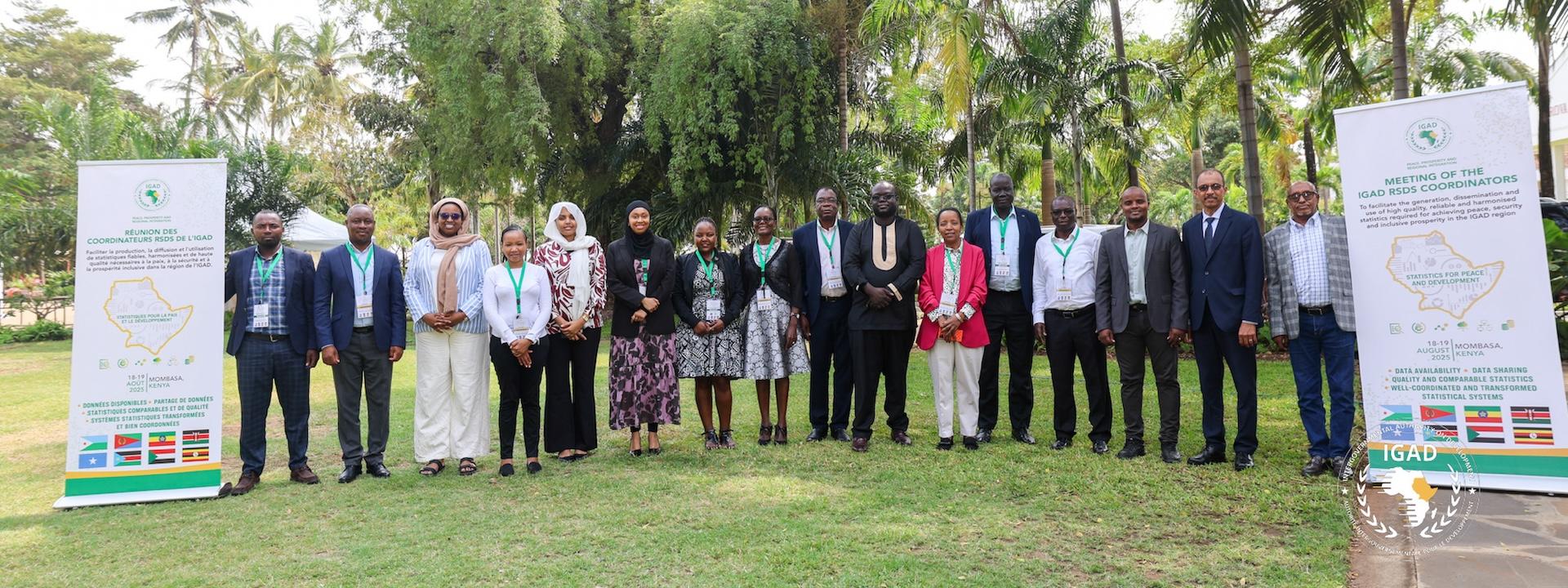
August 19, 2025 (Mombasa, Kenya): The Intergovernmental Authority on Development (IGAD), in collaboration with the African Union Commission (AUC) and key development partners, successfully concluded a high-level meeting of the Regional Strategy for the Development of Statistics (RSDS) Coordinators in Mombasa, Kenya.
The two-day meeting, held from 18–19 August 2025, brought together National Statistical System (NSS) coordinators, IGAD Secretariat staff, and representatives from continental and international institutions, including the African Development Bank (AfDB), World Bank, EU-PAS Programme, UNECA, Statistics Sweden, Statistics Norway, and PARIS21. The forum provided an important platform to reinforce coordination, align national and regional statistical priorities, and guide the future of the IGAD Regional Statistical System.
The IGAD RSDS, developed jointly by IGAD, AUC and partners, is the first-ever statistical master plan for the region. Covering the period 2018–2025, the strategy has strengthened the production of quality, harmonised and reliable statistics to support evidence-based policymaking for regional integration, peace and sustainable development. With the current RSDS approaching its end, the Mombasa meeting marked a critical juncture to consolidate progress and initiate planning for the next phase (2026–2030).
The meeting opened with remarks by Mr. Charles Ogolla, Head of the IGAD Statistics Unit, delivered on behalf of Dr. Fatuma Adan, IGAD Head of Mission to Kenya. She underscored the importance of credible and timely data in shaping policies for peace, security and sustainable development in the region:
“The challenges facing our region demand decisions rooted in credible and timely data. We cannot afford data gaps or fragmented systems.”
Dr. MacDonald Obudho, Director-General of the Kenya National Bureau of Statistics (KNBS), commended IGAD for establishing the RSDS Coordinators’ Working Group, calling it “an opportunity for peer learning, harmonisation and alignment of efforts in strengthening the region’s capacity to produce and disseminate quality statistics.”
Delegates also reviewed the End-Term Evaluation of the RSDS 2021–2025, reflected on lessons learned, and formally endorsed the Terms of Reference of the newly established Coordinators’ Working Group.
On the final day, discussions centred on aligning national and regional strategies with the Second Strategy for the Harmonisation of Statistics in Africa (SHaSA2) – a continental framework designed to strengthen Africa’s statistical systems in support of the African Union’s Agenda 2063 and the Sustainable Development Goals (SDGs).
Delegates explored the vision and structure of the upcoming IGAD RSDS (2026–2030), while development partners reaffirmed their support to IGAD’s statistical agenda. The discussions highlighted the importance of stronger coordination, investment in capacity development, and innovation in data ecosystems to address emerging regional challenges.
A Roadmap for the Future
The meeting concluded with agreement on a roadmap to design the IGAD RSDS 2026–2030, focusing on:
- consolidating lessons from the first RSDS,
- enhancing data availability, quality and comparability,
- aligning with continental and global frameworks such as SHaSA2, Agenda 2063 and the SDGs,
- and strengthening the role of statistics in driving peace, prosperity and regional integration.
By consolidating national and regional priorities, the next RSDS will provide a stronger foundation for evidence-driven policymaking, reinforcing IGAD’s vision of a resilient, peaceful, prosperous and integrated region.