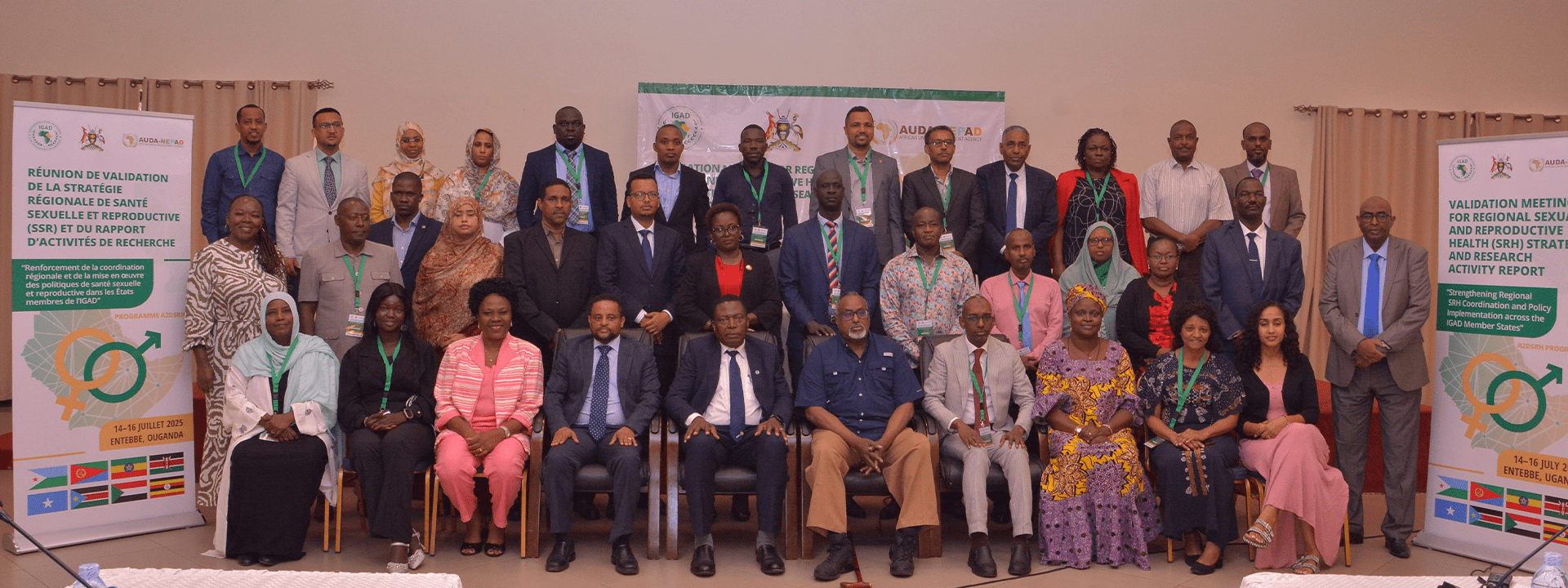
July 15 2025 (ENTEBBE, Uganda): The Intergovernmental Authority on Development (IGAD), through its Africa Demographic Dividend and Sexual and Reproductive Health (A2DSRH) Programme, is convening a high-level workshop with the aim of validating the IGAD Regional Sexual and Reproductive Health (SRH) Strategy and the Research Report on Teenage Pregnancy, to inform policy and programme design and effective implementation at community, national and regional levels.
The regional SRH Strategy aims to advance the Sexual and Reproductive Health (SRH) agenda across IGAD Member States and strengthen IGAD’s capacity to coordinate regional health programmes, acting as a vital step in enhancing SRH policy implementation and agenda.
The Research Study Report on Teenage Pregnancy provides vital insights for evidence-based policymaking, enabling the design of targeted interventions to address adolescent health challenges through regional collaboration. This supports the development and accelerated implementation of youth-focused strategies, thereby providing a foundation for harmonised policies to reduce teenage pregnancy and generally improve reproductive health outcomes across Member States.
During the official opening, H.E. Mohamed Abdi Ware, the IGAD Deputy Executive Secretary, in his welcoming remarks, appreciated the invaluable support from AUDA-NEPAD for partnering with IGAD to advance the sexual and reproductive health agenda across the region. He also thanked the Member States for their commitment and dedication towards the finalisation and endorsement of the Regional SRH Strategy and Teenage Pregnancy Research Report, in alignment with regional health priorities and commitments.
H.E. Ware informed the participants that the A2DSRH Programme is a regional commitment to champion sustainable health solutions and empower the IGAD population, particularly women and youth, to access quality sexual and reproductive health services.
“With the support from AUDA-NEPAD, we are reinforcing IGAD’s capacity to coordinate, harmonise and lead regional health programming in alignment with our collective priorities. We are committed to strengthening this partnership. We remain confident that our continued collaboration will further catalyse transformative, inclusive, and sustainable health outcomes across the region,” H.E. Ware added.
On behalf of AUDA-NEPAD, Dr Hagos Debeb, the Programme Management Unit (PMU) Coordinator – A2DSRH, commended IGAD for its steadfast commitment and leadership in promoting youth empowerment and reproductive health across the Horn of Africa, as well as the participation of Member States for their unwavering dedication to advancing regional health and development priorities.
“This is not only a defining moment but an opportunity to align our shared ambitions with an actionable framework that addresses the region’s most pressing SRH challenges and service delivery as an essential pillar for regional integration, human capital development, and sustainable growth. These important documents will enable Member States to harmonise efforts, attract strategic investments, and accelerate progress towards Universal Health Coverage (UHC) and the Sustainable Development Goals (SDGs),” Dr Hagos said.
The meeting was officiated by Dr Charles Olaro, the Director General of Health Services from the Ministry of Health of the Republic of Uganda.
In his official remarks, Dr Olaro pointed out that the region faces high rates of teenage pregnancies, abortions, HIV/AIDS infections, mental health and substance abuse issues, and a high prevalence of non-communicable diseases (NCDs), among others.
“All these health needs stretch already burdened health systems at national and regional levels. I therefore call on the regional experts from the IGAD Member States to come up with practical and effective SRH and health packages and interventions that are implementable, taking into consideration the reduction in external health financing and the limited national resource envelopes,” Dr Olaro added.
The SRH Strategy provides a harmonised framework to enhance and promote Member States’ SRH policies, promote knowledge exchange, improve service delivery, and reinforce coordination mechanisms and commitments.
The Regional Strategy’s training toolkits will support capacity building, promote policy harmonisation, and facilitate technical assistance for SRH programmes across the IGAD region. Furthermore, the experts are expected to develop an actionable implementation plan.
The AUDA-NEPAD-supported validation workshop is being attended by high-level representatives from Ministries of Health, comprising Directors, Commissioners, M&E and Reproductive Health Experts, as well as health experts from IGAD, AUDA-NEPAD, and regional consultants.