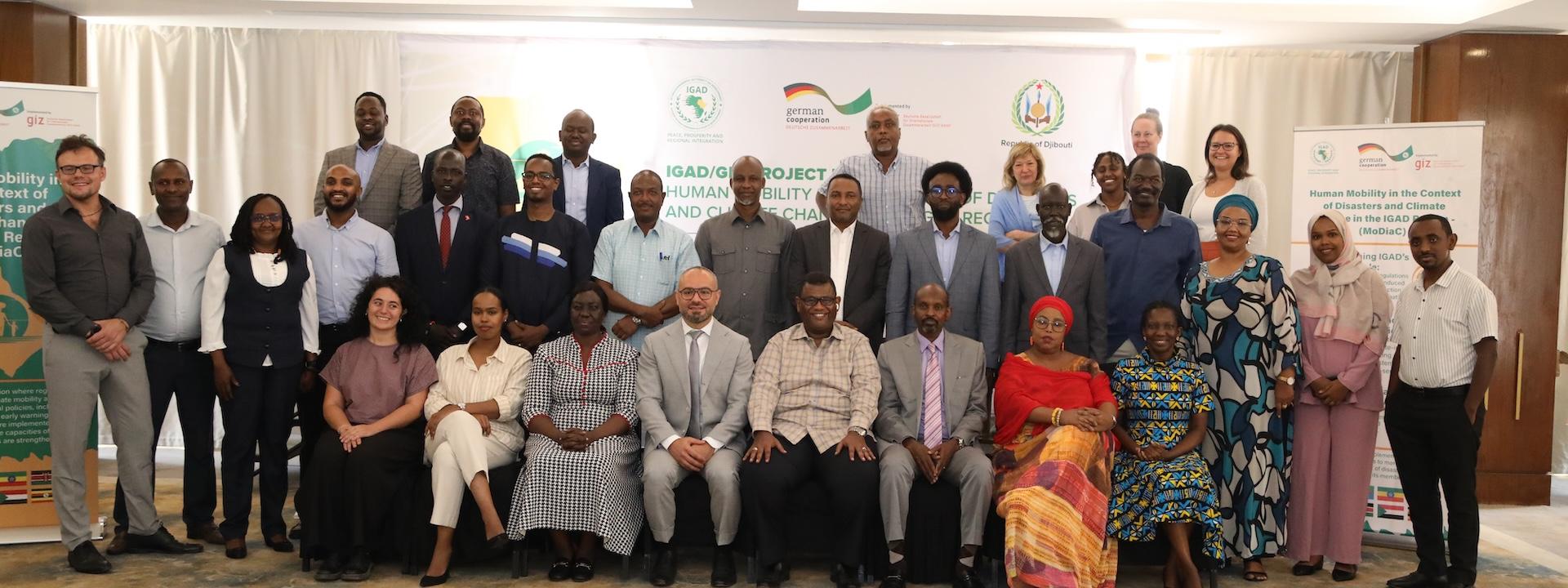
September 15, 2025 (Djibouti, Djibouti): The Intergovernmental Authority on Development (IGAD), with support from the Government of Germany, today launched the Human Mobility in the Context of Disasters and Climate Change (MoDiaC) in the IGAD Region. The initiative aims to strengthen the implementation of IGAD’s regional approaches to managing human mobility caused by disasters and climate change across its Member States.
The IGAD region, home to eight member states, is one of the most climate-vulnerable in the world. In 2022 alone, over 3.5 million people were displaced due to climate-related disasters, including droughts and floods. Climate change is intensifying existing fragilities, driving complex mobility patterns that often cross borders and disproportionately affect pastoralists, women, and youth. Although IGAD has established regional frameworks, such as the Free Movement Protocol and the Migration Action Plan, member states often lack the capacity to translate them into practice.
To address these challenges, the IGAD Secretariat with financial support from the Government of Germany through the German Federal Ministry for Economic Cooperation and Development (BMZ) commissioned through GIZ, will implement the MoDiaC Project to support the implementation of regional approaches to climate- and disaster-induced mobility aiming at strengthening institutional capacities, improve evidence-based planning, and empower local cross-border communities to better manage mobility challenges.
MoDiaC will focus on three priority areas across IGAD and Its Member States:
- Strengthening IGAD’s technical capacities to implement regulations and guidelines on human mobility caused by climate change and disasters in member states
- Strengthening the capacities of the IGAD Climate Prediction and Applications Centre (ICPAC) for analysis, forecasting, and trend identification of the effects of sudden or gradual human mobility caused by climate change and disasters in the IGAD region.
- Strengthening the problem-solving capacities of local actors in the IGAD region with regard to the gender-sensitive management of human mobility caused by climate change and disasters.
The launch of the implementation phase represents a critical milestone in operationalising the approved plan, transitioning from strategic planning to establishing operational frameworks for coordinated regional implementation.
In a statement delivered on his behalf by the Director of Health and Social Development, Ambassador Moussa Meigague, the IGAD Executive Secretary, H.E. Dr. Workneh Gebeyehu, emphasized that MoDiaC represents a continuation of IGAD’s efforts to establish a foundation for a coordinated regional response to human mobility in the context of disasters and climate change.
He said that MoDiaC would enhance IGAD’s technical capacity to support Member States, strengthen ICPAC’s forecasting abilities to anticipate climate-induced mobility, and empower border communities with problem-solving skills.
“IGAD believes in early warning systems that inform rather than alarm, cross-border movement within frameworks of dignity, border communities as centres of innovation rather than zones of vulnerability, and climate adaptation that creates opportunity and cohesion,” said Dr. Workneh in his statement.
Ambassador Guelleh Idriss Omar, Representative of IGAD Chair, the Government of Djibouti said that cross-border cooperation is essential in dealing with displacements due to disasters and climate change.
“Together, we can transform challenges into opportunities and ensure that human mobility, in the face of disasters and climate change, becomes a driver of resilience, peace, and prosperity in the IGAD region,” said Amb. Guelleh.
The MoDiaC Programme Manager at GIZ, Mr. Yaman Hebbo said that the MoDiAC Project was helping to turn regional commitments into practical solutions for the communities most affected by climate change and mobility.
On resilience, Mr Hebbo said that MoDiaC will among others focus on supporting communities in border areas to be better prepared, better protected, and better connected.
The launch was attended by representatives from IGAD Member States, experts from IGAD’s Migration and Forced Displacement Unit, as well as partners including IOM, GIZ, and the British Council.