August 22, 2025, (Djibouti, Djibouti): Child rights and protection experts and their Monitoring and Evaluation counterparts from Ministries responsible for Children Affairs in IGAD Member States, validated the Monitoring and Evaluation Framework for the IGAD Child Policy Framework.
In a virtual event held on August 22, 2025, experts together with regional and international partners involved in the protection of children deliberated and streamlined key performance indicators and associated definitions for tracking progress in relation to each of the thematic areas of the policy.
Participants evaluated and offered feedback on specific indicators within each policy area, focusing discussions on refining the framework to promote measurable, achievable outcomes and tackle challenges related to data collection.
Following the endorsement of the Child Policy Framework, the IGAD Secretariat, in consultation with the IGAD Member States, initiated the process of developing a results-based framework for monitoring the implementation of the IGAD Child Policy in a regional workshop from April 23-24, 2025 in Addis Ababa, Ethiopia, culminating in a draft policy. The M&E framework is meant to streamline accountability at national and regional levels with clear roles and responsibilities.
On behalf of the IGAD Executive Secretary, His Excellency Dr. Workneh Gebeyehu, the Head of Social Development, Dr. Victoria Anib extended gratitude to Member States upon validation of the M&E Framework, calling the process an “official transition from commitment to action.”
Dr. Anib underscored the need for the M&E framework emphasizing that it will provide a foundation for evidence-based strategies to address the complex challenges facing children in the region.
“By generating evidence on whether commitments, resources, and activities are being implemented as planned, we strengthen the ability of Governments and IGAD to be held accountable for both results and impact,” said Dr. Anib.
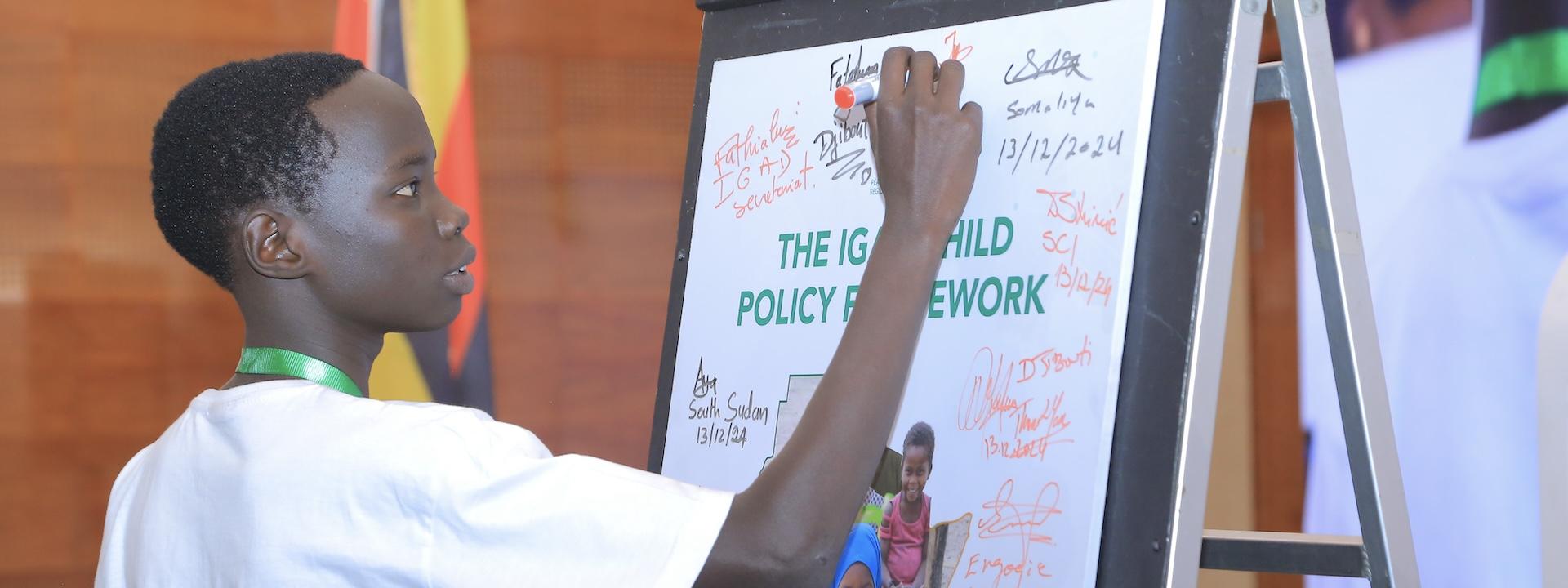
The IGAD Child Policy Framework adopted in December 2024 aims at promoting the rights and welfare of children in the IGAD region. This Policy Framework outlines Member States’ targeted efforts to respect, protection and fulfil the rights of all children in the region, focusing on ten key policy areas. These including; Child Protection, Child Participation, Education, Health and Nutrition. Others are Water, Sanitation and Hygiene (WASH), Environment and Climate Change, Social protection, Justice and in Peace and Security.
The Results Monitoring Framework will track Member States’ progress and evaluate outcomes and impacts of the Policy on children rights and well-being across policy areas.
Representing the IGAD Chair, Mme Fozia Ali Osman, the Director of the Children Affairs at the Ministry for Women and Family, Government of Djibouti, called upon the Member States to take lead in ensuring a solid implementation, monitoring, and accountability mechanism.
“We know that the success of this framework will depend largely on the ownership of each Member State, but also on the support of technical and financial partners, whom I would like to warmly thank for their commitments.”
Ms. Susan Wambui, the Programme Manager at Save the Children Regional and Multi-Country Programmes commended IGAD for the commitment to institutionalise child sensitive and child focused approaches in the bid for regional integration.
“The validation is another significant step to ensuring that we are not only adopt strong policies but also put into place mechanisms to ensure impact, strengthen accountability and that commitments translate into real change for the children in the region,” said Ms. Wambui.
Regional Partners, World Vision International, International Organisation for Migration, the UN Refugee Agency, UNHCR and other regional Civil Society players, participated in the validation exercise.
The development and implementation of the IGAD Child Policy Framework is supported by Swiss Agency for Development and Corporation (SDC) through Save the Children’s East Africa Migration Routes Project.