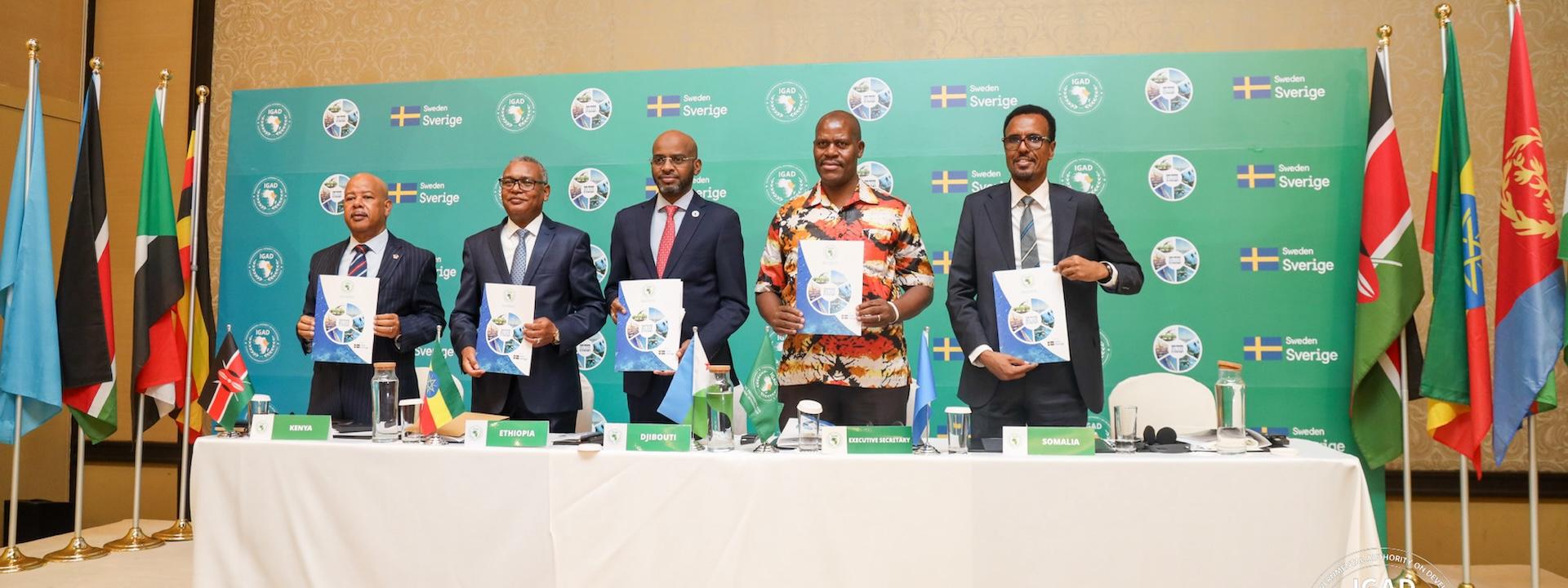
December 4, 2025 (Djibouti, Djibouti): IGAD has taken a major step toward a vision of plastic pollution-free, climate-resilient region with the Ministerial Adoption of the IGAD Regional Plastic Pollution Prevention Strategy and Implementation Plan (2026–2035), adopted today in Djibouti.
Hosted at the Djibouti Palace Kempinski, the Ministerial Meeting was preceded with two days of intensive technical experts consultations where experts from IGAD Member States and other partners such as AUC, AUDA-NEPAD, AU-IBAR, FAO Djibouti, Nairobi Convention and JICA reviewed, refined, and technically validated the draft Strategy. The preparation of the Strategy has been facilitated by the IGAD Blue Economy project, financially supported by the Government of Sweden (Sida). The adoption of this Strategy marks a strong commitment of IGAD Member States to tackling one of the fastest-growing environmental threats in the Horn of Africa-plastic pollution.
Plastic production has surged from 2 million metric tonnes in the 1950s to over 414 million tonnes in 2023, with global projections indicating further acceleration. Mismanaged plastic waste continues to pollute ecosystems, food systems, and water bodies. Although plastic pollution is profoundly transboundary challenge, there is no regional farmwork against plastic pollution prevention. Some IGAD Member States have individual efforts, such as bans on single-use plastics. Therefore, this new regional framework fills gaps and promots:
- A circular economy transition, replacing “produce–use–dispose” systems,
- Source-to-sea approaches that recognise the link between land, rivers, and oceans,
- Harmonised policies, standards, and action plans across the region,
- Managing plastic production and utilization,
- Strengthened waste management and recycling infrastructure
- Innovation, private-sector engagement, and extended producer responsibility
Today, IGAD Member States reaffirmed their collective responsibility to protect shared ecosystems and advance a circular, sustainable, and climate-resilient future. Member State Ministers delivered statements committing to coordinated action on plastic pollution preventions, strengthened environmental governance, and regional monitoring of waste flows.
They adopted a Communiqué that strongly recommends IGAD Secretariat to mobilise resource and domesticate the regional IGAD Plastic Pollution Prevention Strategy (2026-2035) to its Member States and support the develop of harmonised national plastic pollution prevention strategies guided by a common regional framework.
In conclusion, IGAD using this regional framework, will work closely with its Member States to support in combating plastic pollution:
- Development of national action plans,
- Capacity strengthening for standards and regulators formulation and compliance,
- Knowledge sharing, establishing database systems, and awareness campaigns
- Promoting recycling, use of alternatives, and improved waste collection systems
- Partnerships with development partners, private sector, and local innovators