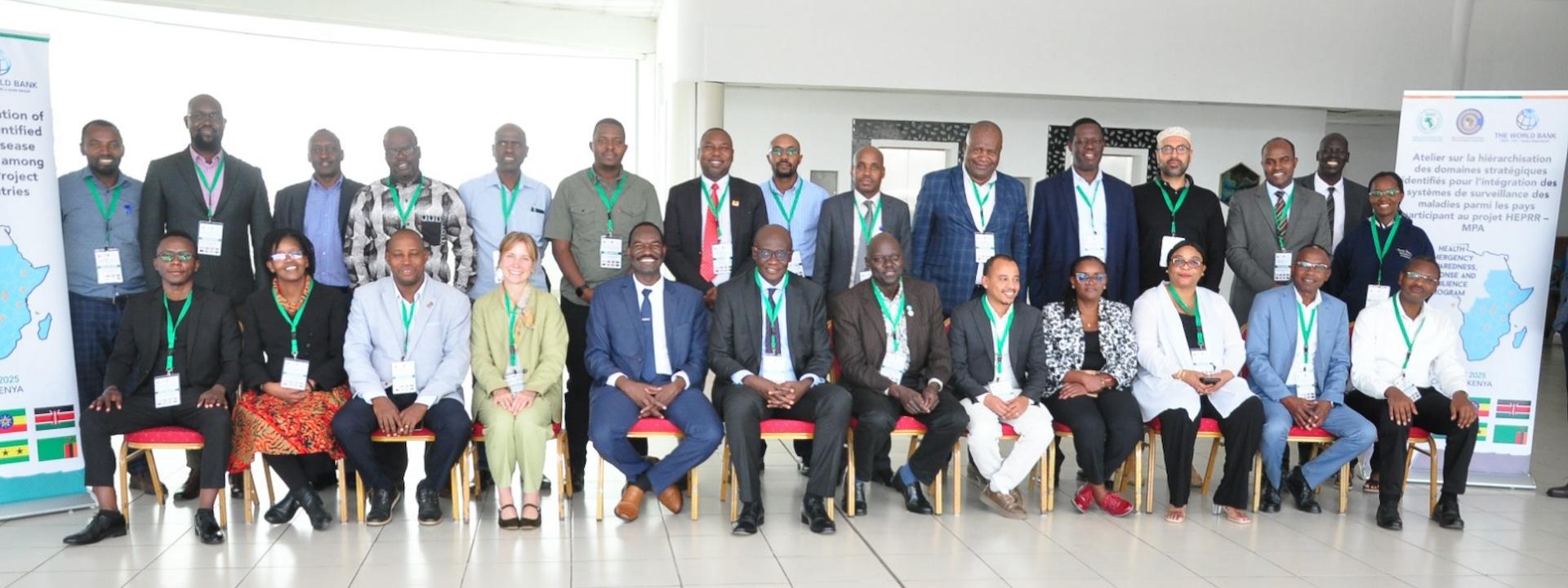
August 8, 2025 (Machakos, Kenya): The IGAD Secretariat, in collaboration with the East, Central, and Southern Africa Health Community (ESCA-HC) and various partner organisations conducted a regional workshop on the prioritisation of Strategic Domains identified for Integration of Disease Surveillance Systems (IDSS) among Eastern and Southern African (AFE) countries implementing the Health Emergency Preparedness, Response and Resilience Programme (HEPRRP).
The meeting held from August 6th – 8th in Machakos, Kenya, aimed at prioritizing key domains for integration of surveillance systems for human, animal and environmental sectors, with a focus on enhancing the detection, prevention, and control of health threats in the AFE region.
Experts in human, animal, and environmental health surveillance from HEPRRP – Multiphase Programmatic Approach (MPA) participating countries including, the Democratic Republic of Congo (DRC), Burundi, Ethiopia, Kenya, Sao Tome and Principe, Malawi, Rwanda and Zambia deliberated key priorities for integrating animal and environmental surveillance into existing disease surveillance systems in health.
The meeting underscored the need for Integrated Disease Surveillance Systems as a practical response to the growing complexity and interdependence of global and regional health threats.
The One Health approach advocates for the integration of surveillance systems across various sectors, promoting collaboration between human health, animal health, and environmental agencies.
Speaking on behalf of the IGAD Executive Secretary, Dr. Mohamed Elduma, Head of the IGAD Health Unit, underscored the persistent danger of cross-border disease transmission, a challenge worsened by fragmented, sector-specific surveillance systems that often fail to communicate across human, animal, and environmental health sectors.
Dr. Elduma emphasized that the workshop was a vital step toward building a shared regional vision for integrated, multi-sectoral, and people-centred surveillance systems that can respond effectively to the region’s complex health threats.
The workshop was organised with support from other partners including, World Health Organization (WHO), Resolve To Save Lives (RTSL), African Centres for Disease Control and Prevention (AFCDC), World Organization of Animal Health (WOAH), the East African Community (EAC) and International Livestock Research Institute (ILRI).
Dr. Patrick Amoth, the Director General for Health at the Ministry of Health, Government of Kenya, said that the rising burden of health emergencies in the region was not only threatening human lives, but also economies, food systems, and ecological stability.
He said that they had also seen the transformative power of coordinated action, whether through cross-border disease investigations, data sharing during pandemics, or joint response units in emergencies.
“It is a call to action to break down sectoral silos, pool our expertise, and forge a coordinated regional response that reflects the true complexity of the health threats we face,” emphasised Dr. Amoth.
Participants reviewed the shared priorities for integration of surveillance system, identified shared opportunities to integrate surveillance systems for better early detection and response to health threats at the country level, and discussed mechanisms for integration of surveillance systems across human, animal, and environmental sectors, among others.
In proposing next steps, participants agreed to develop a framework for integration of surveillance system, including an implementation guideline. Participants also agreed to explore collaborative opportunities with partners organizations to support the development of the frameworks and the domestication of the proposed framework at country-level.
About HEPRR-MPA
The Health Emergency Preparedness, Response and Resilience Programme (HEPRRP) for Eastern and Southern Africa (AFE) is funded by the World Bank aims at strengthening health system resilience and multi-sectoral preparedness and response to health emergencies in the AFE region
The IGAD Secretariat and ECSA-HC are the regional coordinating organizations supporting implementation through a Multiphase Programmatic Approach (MPA). Ethiopia, Kenya, Burundi, Rwanda, DRC, Malawi, Sao Tome & Principe and Zambia are currently the participating Countries.