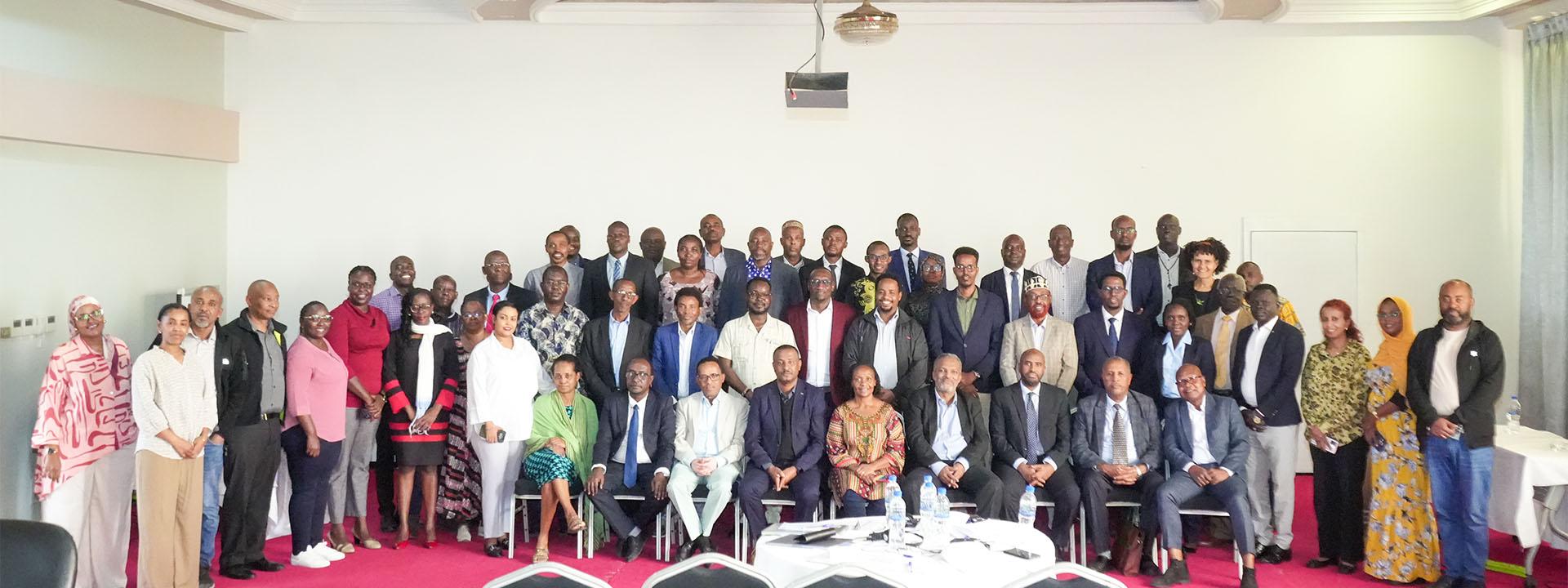
August 6, 2025 (Adama, Ethiopia): The Intergovernmental Authority on Development (IGAD), through its Food Systems Resilience Programme (FSRP), is convening a three-day Regional Validation Meeting to review and validate data for the 5th Biennial Review (BR) of the Comprehensive Africa Agriculture Development Programme (CAADP).
The meeting brings together key stakeholders from IGAD Member States including Djibouti, Ethiopia, and Somaliato prepare and validate their national datasets for submission to the African Union Commission (AUC). This regional exercise is a critical step in assessing Member States’ progress toward the agricultural transformation goals set out in the 2014 Malabo Declaration.
The CAADP Biennial Review is the African Union’s flagship accountability mechanism for monitoring progress on agricultural development across the continent. Now in its fifth cycle, the process has been strengthened with improved indicators and a more robust electronic Biennial Review (e-BR) system. However, data quality and availability continue to pose challenges, particularly across IGAD countries.
During the opening ceremony, H.E. Girma Bekele, Principal Secretary at Ethiopia’s Ministry of Agriculture, officially opened the meeting and emphasised: “Data is related to the life of people in our countries, because it can describe properly the livelihood conditions of our people, and it can support the development of policies.” He acknowledged that “up to the 4th Biennial Review, we didn’t meet our commitments,” stressing the need for improved alignment with CAADP and international frameworks. He highlighted Ethiopia’s Home-Grown Economic Reform Programme, launched seven years ago, which is grounded in indigenous knowledge and local resources while leveraging international expertise.
He noted that agriculture, mining, industry, tourism, and ICT are Ethiopia’s key sectors for economic growth, adding that gold exports recently surpassed coffee for the first time. Several strategic agricultural initiatives were mentioned, including the Green Legacy, irrigated wheat programme, rice initiatives, and the Bounty Basket Initiative focusing on honey and poultry. Ethiopia’s forest coverage has increased from 3%, with over 40 billion seedlings planted until last year and an additional 7 billion in 2025, mostly comprising multi-purpose trees. He also mentioned that wheat is now an import-substitution crop and that Ethiopia is on its way to becoming a wheat exporter. On rice, he expressed optimism that the country would stop importing rice within 2–3 years.
The region continues to face multiple and interlinked threats, including climate change, conflict, invasive species, and forced displacement, which have collectively contributed to worsening food insecurity. As of the latest figures, 62.9 million people across IGAD Member States are food insecure. Given that over 70% of the region’s population relies on agriculture for their livelihoods, accurate and reliable data is essential for informing policy, attracting investment, and guiding sustainable development interventions.
Representing IGAD Executive Secretary H.E. Dr. Workneh Gebeyehu, Mr. Abebaw Bihonegn, IGAD Head of Mission to Ethiopia, described the data validation exercise as a moment to reflect on regional experience, measure progress, and shape the next chapter of agricultural investment and resilience. “Today, we gathered here to review a data that has captured our regional experience, measured our impact, and set the stage for the next chapter of agricultural investment and resilience building through CAADP,” he said. He further encouraged participants to use the opportunity to reinforce partnerships among the RECs, AUC, development partners, civil society, and the private sector.
The Adama meeting aims to consolidate and verify the data collected at the national level. Participants include CAADP country coordinators, technical experts, IGAD officials, and other stakeholders engaged in agricultural data and policy. The validation process ensures that submissions to the AUC meet the necessary standards for accuracy, consistency, and relevance.
This collaborative effort is taking place in partnership with the AUC, EAC, and COMESA, who are also supporting Member States in the CAADP BR process. Due to conflict and logistical challenges, Sudan was unable to participate in this session. Meanwhile, Kenya, South Sudan, and Uganda are participating under the coordination of the East African Community (EAC) with support from AGRA.
Mr. Daher Elmi, Director for Agriculture and Environment at IGAD, called for practical recommendations to overcome Member States’ persistent data availability challenges. “It is critical that this meeting comes up with recommendations on how Member States can overcome data availability challenges. This also requires stepping up our efforts for resource mobilisation to address this challenge,” he said.
At the conclusion of the meeting, participating countries are expected to integrate the feedback and recommendations received and resubmit their country reports through the e-BR platform. This will be followed by a continental data validation exercise, to be organised by the African Union Commission in mid-August 2025.
The CAADP Biennial Review remains a cornerstone of Africa’s drive for agricultural growth and resilience. Through this regional validation, IGAD reaffirms its role in supporting Member States with the tools, knowledge, and partnerships needed to realise the continent’s shared vision under Agenda 2063.