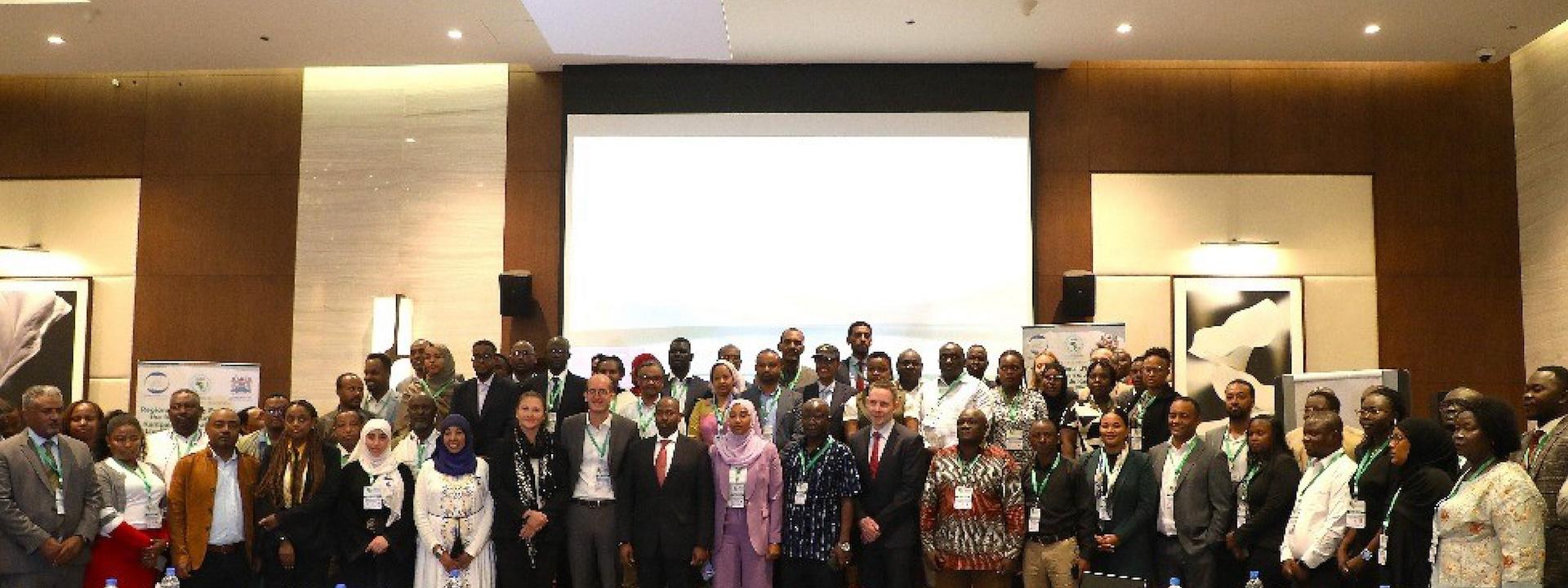
October 24,2025 (Addis Ababa, Ethiopia): The Intergovernmental Authority on Development (IGAD) held a regional learning exchange event on the implementation of the Kampala Declaration on Jobs, Livelihoods, and Self-Reliance for Refugees, Returnees, and Host Communities, in the IGAD Region, under the theme “Unlocking Private Sector Potential for Inclusive Economic Growth for Refugees, Returnees, and Host Communities – Experiences from Ethiopia and Kenya,” from, 20 – 23 October 2025, in Addis Ababa, Ethiopia.
The event is jointly organized by the IGAD Regional Policy Dialogue and Knowledge Exchange on Development Responses to Forced Displacement in the Horn of Africa (RPD-DRFD) and Stregthening IGAD Migration Policy Implementation (SIMPI) funded by the World Bank and the Government of Germany implemented through GIZ.
Speaking on behalf of the Director of the Health and Social Development Division, Ms. Yemisrach Benalfew, Coordinator, Strengthening IGAD’s Migration Policy Implementation (SIMPI) Project, IGAD, emphasized that the Kampala Declaration focuses on creating an enabling environment for economic inclusion, specifically on jobs, livelihoods, and self-reliance for refugees and their host communities.
She also emphasized that the Declaration represents a commitment to moving beyond traditional humanitarian aid towards sustainable, long-term solutions that empower displaced people and support the communities that host them. “It calls upon all of us to move beyond humanitarian response — toward long-term economic solutions and committed Member States to promoting the economic self-reliance of refugees, returnees, and host communities in the IGAD region,” she added.
In his opening remarks, Mr. Solomon Soka, State Minister – Ministry of Labour and Skills in the Federal Democratic Republic of Ethiopia, explained that one of the most significant milestones in this process has been the inclusion of refugees in Ethiopia’s Labor Market Information System— the national digital platform linking job seekers with employers and serves as the backbone for our employment governance and analytics.
He described that Ethiopia, through the Ministry of Labor and Skills, carries a transformative mandate to advance inclusive and sustainable economic growth by developing a competent and competitive workforce, fostering productive employment and enterprise opportunities, and strengthening the national labor market system in line with the country’s economic reform agenda, “We also value our regional cooperation under the IGAD Support Platform, which continues to serve as a vital coordination mechanism for implementing the Kampala Declaration and promoting shared learning among Member States,” The State minister expressed.
In his address, Mr. Jashon K. Awour, Deputy Commissioner of Kenya’s Department of Refugee Services (DRS), stated that the Shirika Plan is a multi-year plan to transform refugee camps into integrated settlements and to promote the socio-economic inclusion and self-reliance of refugees and host communities. Building on the progress made so far, the Government of Kenya is shifting its approach to refugee management.
According to the Deputy Commissioner, the Shirika Plan will involve a wide range of sectors, including education, water, sanitation and hygiene, health and nutrition, livelihoods, self-reliance, social protection, environmental management and energy, agriculture, housing, land and property, and durable solutions.
On her part, W/ro Teyiba Hassen, the Director General of Ethiopia’s Refugees and Returnees Service (RRS), highlighted that RRS has institutionalized a whole-of-government approach, ensuring coordinated service delivery and multi-sectoral inclusion. “We call upon our partners, development actors, and the private sector to join hands in translating commitments into impactful actions that allow refugees to live with dignity, contribute to national development, and share in the prosperity of their host communities,” the Director General urged.
Mr. Mathew Stephens, Lead Social Development Specialist at the World Bank said that policy dialogue also often takes place in the context of countries accessing funding through the Bank’s window for Host Communities and Refugees (WHR). “Through the WHR, we’ve pursued different approaches in IGAD countries. We have supported IGAD’s impressive efforts through the Nairobi Process to formulate a set of progressive regional policies on forced displacement,” He stressed.
Mr. Fabien de Castilla, Chief Executive Officer, Konexio, provided an overview of efforts undertaken by Konexio in Kenya in relation to the objectives of the Kampala Declaration. In Kenya, Konexio has launched its Digital Inclusion Programme (DIP) targeting refugee and host-community women offering approximately six-month training curricula that combine digital literacy, online freelancing skills and entrepreneurship support, enabling trainees to generate income from digital platforms within three months. By strengthening the digital livelihoods of displacement-affected women and connecting them to employment opportunities in the digital economy, Konexio advances the Kampala Declaration’s goals of inclusive economic participation, self-reliance, and sustainable livelihoods for refugees, returnees, and host communities in the IGAD region.
The regional learning exchange brought together a diverse group of stakeholders actively engaged in advancing the Kampala Declaration on Jobs, Livelihoods, Self-Reliance, and Local Economic Development in contexts of forced displacement across the IGAD region.
The lead organizers and partners are the IGAD Secretariat, Refugees and Returnees Service (RRS), Government of Ethiopia, and Kenya’s Department for Refugee Services (DRS), with technical and financial support from The World Bank, GIZ, and Refugee Investment Network (RIN).
The event concluded with concrete short- and long-term plans for refugees, returnees, and host communities. The exchange provided a comprehensive collection of best practices and actionable recommendations to improve the enabling environment for private sector engagement in forced-displacement settings, including tax incentives, simplified business registration processes, improved access to finance for businesses, strengthened peer-to-peer networks.
In March 2019, the IGAD Member States came together in Kampala and made a bold declaration aimed at enhancing refugee self-relaince and dignity leading to the Kampala Declaration.