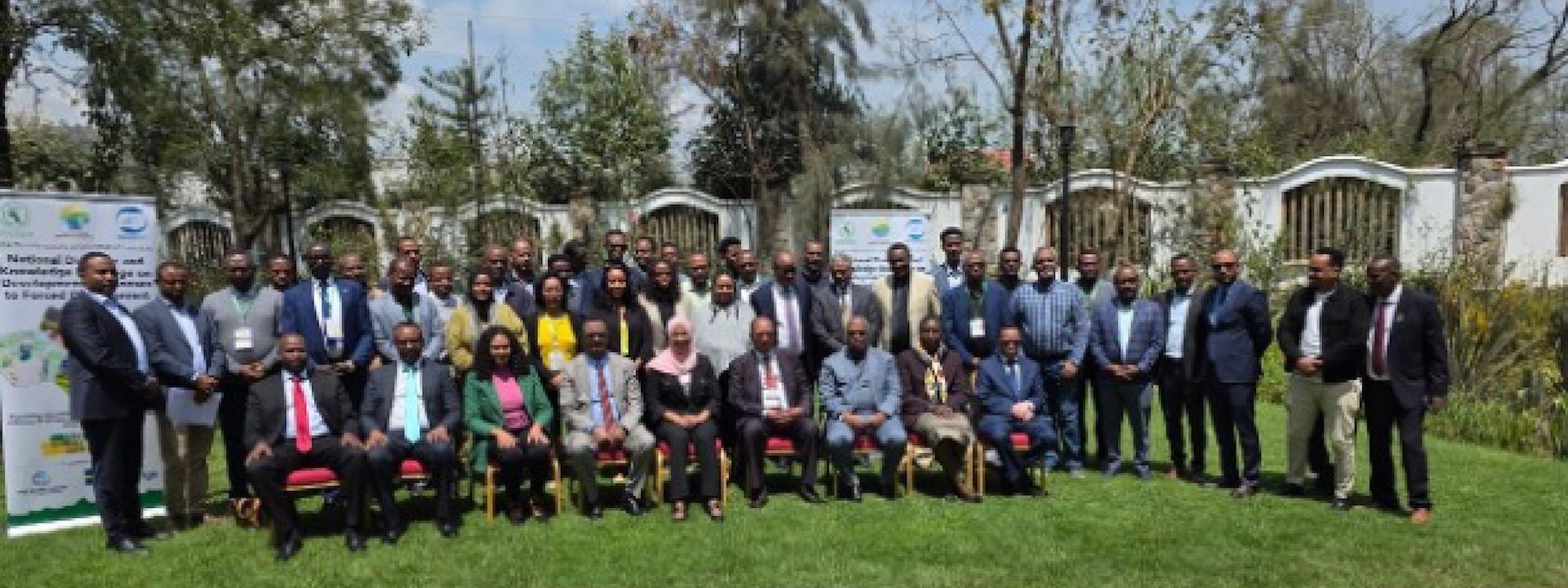
August 16, 2025 (Bishoftu, Ethiopia): The Intergovernmental Authority on Development (IGAD) held a National Dialogue and Knowledge Exchange on Development Responses to Forced Displacement in Ethiopia.
The main objective of the three-day dialogue was to foster a whole-of-government and whole-of-society approach and to strengthen partnerships between the Refugee and Returnee Service, the Development Response to Displacement Impacts Project (DRDIP) teams, line ministries, and development actors.
Speaking on behalf of Dr. Workneh Gebeyehu, Executive Secretary of IGAD, Mr. Abebaw Bihonegn, IGAD Head of Mission to Ethiopia, noted that IGAD has been at the forefront of regional policy initiatives towards durable solutions through the IGAD Support Platform. He further emphasised that the DRDIP approach places refugees and host communities at the centre of identifying, contributing to, and implementing development priorities that strengthen social cohesion. “IGAD remains committed to working with our partners to ensure that refugees are contributors to national development, rather than passive recipients,” he added.
In his opening remarks, Dr. Melesse Mokonnen, State Minister of Agriculture of Ethiopia, underlined Ethiopia’s leadership in promoting a progressive refugee policy framework that grants the right to work, freedom of movement, access to education, healthcare, and full participation in society. He noted that DRDIP is a cornerstone of this vision: “Refugees are now direct beneficiaries. Women’s economic and social empowerment is a central focus, and our reach extends to all communities affected by displacement, both rural and urban,” he said.
Dr. Dereje Duguma, State Minister of Health of Ethiopia, highlighted that refugees are benefiting from access to primary health facilities and are included in health campaigns and disease prevention activities, a practical example of Mekata(inclusion in practice). He reaffirmed the Ministry’s commitment to providing essential health services to refugees and recognised the significant contribution of DRDIP.
Mrs. Teyba Hassen, Director General of the Refugee and Returnee Service, emphasised that a key national instrument aligning with DRDIP II is the Makatat Road Map, which embeds refugee inclusion into national and local development systems. She also commended IGAD’s leadership, noting that, “IGAD’s support, alongside our valued partners, has been instrumental in advancing Ethiopia’s efforts towards an inclusive, sustainable and coordinated response for refugees and host communities alike.”
Addressing the workshop, Ms. Margaret Atieno, representing the UN High Commissioner for Refugees (UNHCR), praised Ethiopia’s progressive framework that aligns with the Global Compact on Refugees. “The Development Response to Displacement Impacts Project II is directly benefiting both refugees and host communities, expanding geographical coverage, strengthening social cohesion, women’s empowerment and livelihoods,” she noted.
Representatives from the Ministry of Justice of Ethiopia and the World Bank also delivered remarks.
The dialogue brought together representatives from government ministries, regional authorities, the Refugee and Returnee Service, the World Bank, UNHCR, and IGAD. The event was funded by the World Bank and the Government of Sweden.
The workshop demonstrated a whole-of-government approach, with participants committing to accelerate the implementation of the Makatat (Inclusion) Road Map, strengthen coordination across federal, regional, and woredalevels, scale up economic inclusion and livelihood opportunities, enhance data systems, and improve the use of evidence for policy and planning.
Ethiopia currently hosts over one million refugees, making it the third-largest refugee-hosting country in Africa. This commitment is demonstrated through Ethiopia’s pledges at the 2016 New York Leaders’ Summit, the 2019 Refugee Proclamation, and its role as a signatory to the Global Compact on Refugees.
Key corrections made:
-
Fixed subject-verb agreement (e.g. objectives are → objective was).
-
Corrected typos (partner ships → partnerships, work shop → workshop).
-
Smoothed long sentences and improved consistency in titles (e.g. Executive secretary → Executive Secretary).
-
Clarified names of initiatives (Makatat Road Map, DRDIP).
-
Removed redundant phrasing and tightened flow for readability.