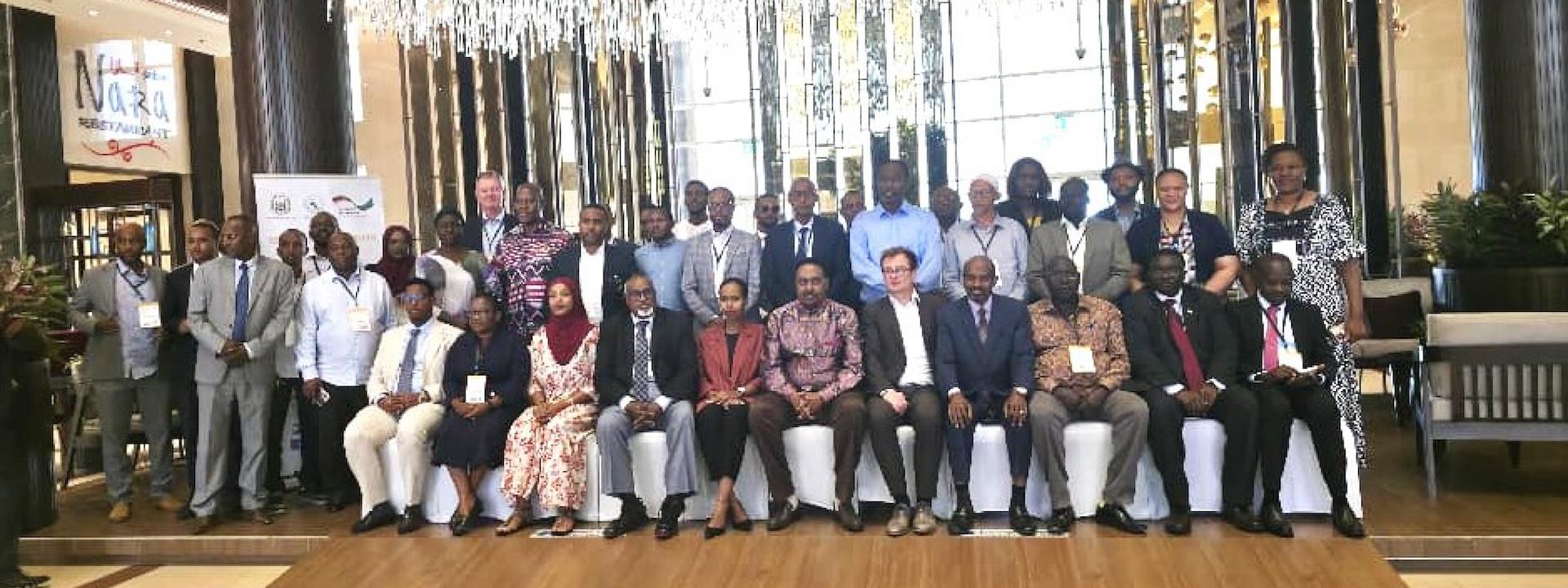
November 20, 2025 (Ali Sabieh, Djibouti): The Executive Secretary of the Intergovernmental Authority on Development (IGAD), H.E. Dr Workneh Gebeyehu, presided over the 5th Annual Steering Committee Meeting of the Regional Migration Fund (RMF).
In his opening remarks, H.E. Dr Workneh Gebeyehu emphasised that the Regional Migration Fund has grown into one of IGAD’s most practical instruments for translating policy vision into concrete impact. He explained that the Fund brings services, opportunities, and infrastructure directly to communities along migration routes — communities often far from capital cities and underserved by traditional development programmes. The RMF also strengthens coordination, clarifies roles, and embeds monitoring systems that ensure results are both measurable and meaningful.
Saying, “We recognize the commitment of all IGAD Member States, whose ownership remains the foundation of the RMF’s credibility and sustainability,” Dr Workneh stressed that IGAD remains committed to fast-tracking decisions, enhancing technical oversight, and delegating responsibilities appropriately to ensure timely delivery in line with the Financing Agreement.
He highlighted that through the RMF, IGAD is working to improve key migration corridors, including Moyale–Moyale, Tog-Wajale, Nimule–Elegu, and the refugee-hosting areas of Addeh and Ali Sabieh, to promote safety, opportunities, and well-being for all. Expressing gratitude to the Federal Republic of Germany, he added: “I express our deep appreciation to the Government of Germany for its strategic partnership, which has been central to the RMF’s impact.”
Speaking on behalf of the Minister of Foreign Affairs, H.E. Abdoulkader Houssein Omar, and H.E. Ambassador Guelleh Idriss Omar, Ms Yasmine Djama, Deputy Director of Regional Organisations at the Ministry of Foreign Affairs and International Cooperation of Djibouti, highlighted that over the past two years the RMF has gained momentum with faster delivery, clearer implementation systems, and stronger coordination among IGAD, Member States, and partners.
She noted that the experience in Ali-Sabieh and Ali-Addeh demonstrates the tangible results of collaboration and shared vision. Djibouti is particularly pleased with key infrastructure projects, including the Lycée Technique, the Community Development Centre, and the Migrant Orientation Centre.
She stressed, “We remain committed to supporting the completion of the remaining projects, particularly the two market centers, in close cooperation with our national institutions and local authorities.”
During the opening ceremony, Amb. Moussa Meigag, Director of the Health and Social Development Division, noted that over the past year and a half, the implementation of the Regional Migration Fund has undergone a comprehensive review of the operational modality initially designed six years ago.
Mrs Julia Hannig, Head of the East Africa Division at the German Federal Ministry for Economic Cooperation and Development (BMZ), delivered her remarks virtually, reaffirming Germany’s continued support to IGAD and the RMF.
Field Mission to Ali Sabieh
Following the meeting, the 5th RMF Steering Committee Members undertook a field mission to Ali Sabieh, visiting one of the two community market infrastructures under construction within the IGAD RMF project in Djibouti, the second being the Ali Addeh Market. The project aims to strengthen local economic development and social cohesion between host communities, refugees, and migrants through improved commercial infrastructure and accompanying measures.
Ali Sabieh Market Infrastructure
-
24 shops
-
48 open stalls
-
Total Gross Floor Area: 1,255 m²
-
Market Management Committee (MMC) office
-
Separate male and female sanitation facilities
-
Technical rooms supporting overall site operations
The Steering Committee Members also visited the completed rehabilitation works at the Lycée Technique, where the project fully rehabilitated:
-
4 workshop buildings
-
28 classrooms
-
The administration block
-
The students’ canteen
Additionally, 4 new dormitories were constructed. The upgraded facility will now accommodate an additional 200 students, mainly refugees.
IGAD, in partnership with the Government of Germany through its development bank KfW, launched the Regional Migration Fund in 2019. This followed feasibility studies conducted in 2016–2017, which identified pressing migration-related challenges and opportunities across the region and recommended targeted interventions.