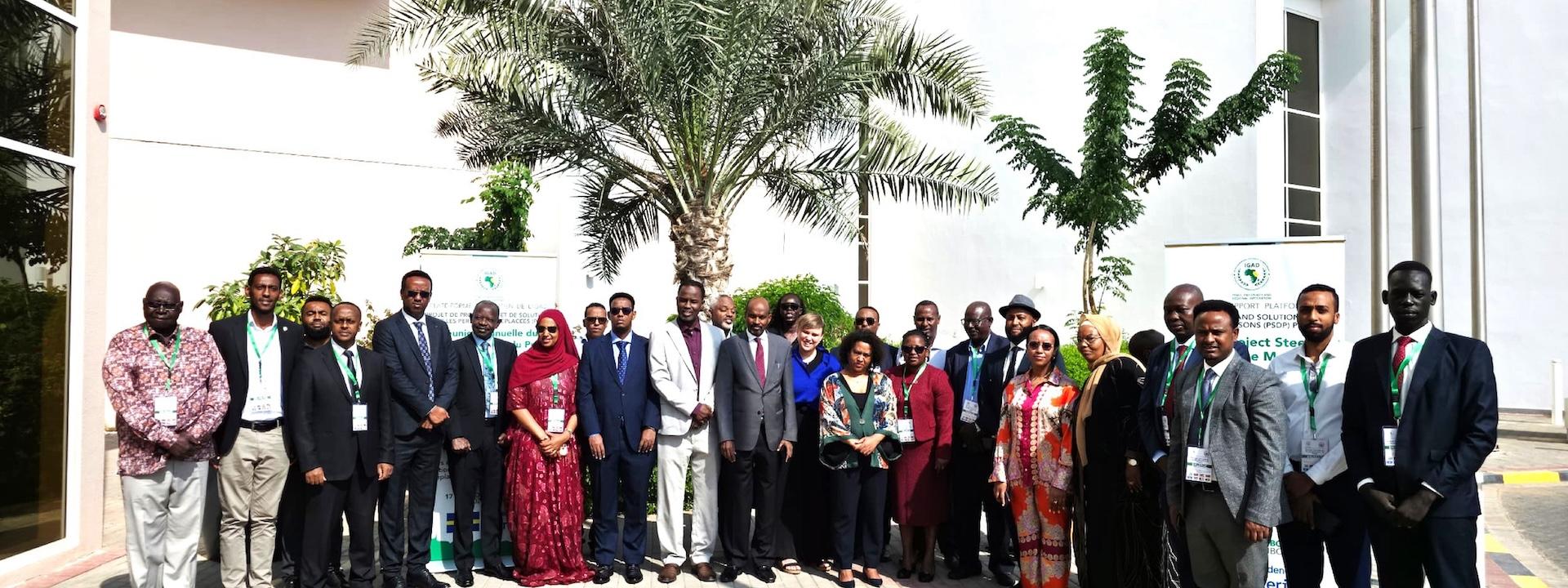
November 19, 2025 ( Djibouti City, Djibouti): The Intergovernmental Authority on Development ( IGAD) convened the second Project Steering Committee Meeting for the Protection and Solutions for Displaced Persons Project, to support IGAD member states in the implementation the key priorities and recommendations outlined in the Regional Refugee Protection Policy Framework, promoting its full realisation at both national and regional level. The meeting was convened in Djibouti City.
The overall objective of the two-day Steering Committee Meeting To review progress, strengthen coordination, and provide strategic direction for the effective implementation of the programme, ensuring alignment with regional priorities, Member State needs, and the agreed workplan.
Speaking on behalf of Dr. Workneh Gebeyehu, the Executive Secretary of the IGAD, Amb Moussa Meigague , Director Health and Social Development Division, spoke to the timeliness of the meeting, emphasizing that it comes at a moment when the region is confronting escalating levels of forced displacement that require strengthened coordination and renewed collective action. Despite these pressures, IGAD Member States continue to show exceptional solidarity, offering protection and support to millions of displaced people with limited resources.
He highlighted that, through the project, IGAD, in close collaboration with Member States and with the invaluable support of the Government of Sweden, has taken significant steps to strengthen protection mechanisms for national policies and institutions, improve national and regional coordination efforts, and advance durable solutions for displaced populations in the region as a whole.
Amb. Moussa expressed appreciation to the Embassy of Sweden for its steadfast partnership and commitment to the region’s humanitarian and development priorities. He also acknowledged the strong engagement of Member States particularly the refugee agencies and commissions whose leadership and ownership remain essential to achieving sustainable, long-term solutions.
In his opening remarks, Mr. Houssein Mohamed Chardi, Deputy Executive Secretary of the National Office for Assistance to Refugees and Disaster Victims (ONARS) and representative of the IGAD Chair, reflected on the situation in Djibouti, where refugees constitute more than 3% of the national population. This reality demonstrates a major challenge faced across the region: Member States continue to shoulder a disproportionate burden of forced migration, often with very limited resources. He stressed the timeliness of the meeting, noting that it comes at a moment when growing displacement pressures demand stronger regional coordination and renewed collective action.
Mr. Chardi emphasized that the IGAD regional platform plays an important role in strengthening cooperation among Member States, harmonizing protection policies, mobilizing regional and international resources, and pooling institutional capacities to respond effectively to the increasing needs of refugees. “Through this platform, we can consolidate the autonomy of displaced people, foster their local integration, and promote durable solutions, whether socio-economic inclusion, voluntary repatriation, or resettlement,” he stated.
Speaking on behalf of the Embassy of Sweden in Ethiopia, Ms. Agnes Geijer-Farah, Program Manager for Migration and Development, Regional Development Cooperation for Africa, highlighted key achievements recorded over the past period. She noted significant progress across project outcomes, including the validation of the IGAD Policy Framework on Refugee Protection indicators and the establishment and launch of the Regional Refugee Engagement Forum. She also cited the comprehensive mapping of refugee-led organizations, institutional capacity needs assessments, facilitation of knowledge exchange and documentation, national multi-stakeholder dialogues, regional advocacy on statelessness pledges, and the publication of the Gender Analysis Report on the dynamics of forced displacement in the IGAD region.
Ms. Geijer-Farah reaffirmed Sweden’s strong partnership with IGAD, explaining that the consolidation of Sweden’s support aims to better align assistance with IGAD’s core mandate, reduce administrative burdens, and enhance IGAD’s institutional leadership. “This shift is intended to reinforce IGAD’s capacity to act as a unified institution, ensuring that our collective efforts deliver sustainable impact. This project is currently the only exception to this consolidation,” she added.
During the opening ceremony, Ms. Teresa Diing, Team Leader for Refugee and Displacement Management, Health and Social Development Division at IGAD, recalled that the first Steering Committee Meeting had set the governance arrangements and work modalities. She noted that the second meeting would focus on reviewing progress, addressing implementation challenges, and consolidating the way forward for the coming year.
The meeting brought together representatives from refugee agencies and commissions, including commissioners, heads of protection, ministry of foreign affairs and the donor to ensure collective guidance and oversight. The second annual Steering Committee Meeting subsequently endorsed the 2026 Action Plan and outlined the key priorities for the year ahead.
The Project Steering Committee will continue to convene annually to review progress, assess challenges, and take strategic decisions to ensure effective implementation and long-term sustainability, in line with the project’s goals and objectives.