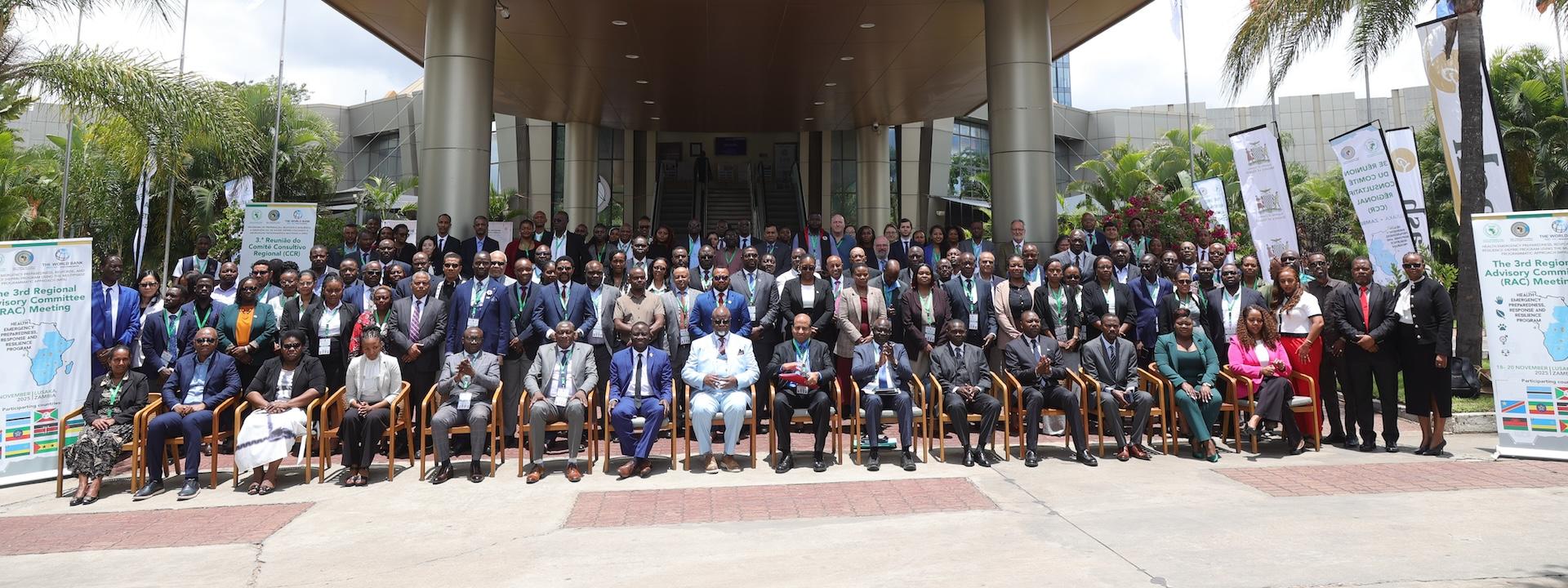
November 20, 2025 (Lusaka, Zambia): Delegates from participating countries in the Health Emergency Preparedness, Response and Resilience (HEPRR) programme for East and Southern Africa convening at the 3rdRegional Advisory Committee (RAC) meeting in Lusaka, Zambia, reaffirmed their commitment to strengthening readiness and response mechanisms and pledging closer collaboration in tackling the escalating number of health emergencies affecting the region.
The 3rd RAC, held from 18 to 20 November 2025, brought together HEPRR – MPA program participating countries; Ethiopia, Kenya, Botswana, Burundi, Democratic Republic of Congo, Rwanda, São Tomé and Príncipe, Malawi, Mozambique and Zambia —and partners to enhance coordinated action and strengthen regional collaboration for health emergency preparedness and response.
The RAC serves as the Program’s strategic governance and oversight body mandated with providing strategic direction, fostering regional collaboration, ensuring alignment between national and regional priorities, and strengthening stakeholder engagement.
At the RAC meeting, delegates and partners shared valuable lessons and best practices, enriching collective knowledge across the region. Several plenary and panel sessions were held, covering topics such as strengthening public health stewardship, cross-border coordination and collaboration, accelerating health manufacturing in Africa, and digital interventions to enhance preparedness and response in health emergencies.
Calls for renewed effort and collaboration
In his opening remarks, the Minister of Health, Government of Zambia, Hon. Dr Elijah Muchima stressed the need for unity to solve persistent health challenges, specifically citing fragmented surveillance, unequal emergency financing, and limitations in vaccine access at both country and regional levels.
Hon. Muchima said that the rising political will, technological innovation, and expanding partnerships must now be consolidated into a regional roadmap for resilient health systems.
“Through solidarity and shared purpose, we can transform this platform into a true engine of regional health security, one that leaves no member state behind.”
Representing the IGAD Executive Secretary, the Director Planning and Coordination, Dr. Anthony Awira remarked that the increasing participation in the HEPRR program was a recognition that no single country could manage modern health threats alone.
Dr. Awira highlighted that during the two years of the HEPPRP implementation, the region faced serious health threats, including cholera, mpox, Ebola, and Marburg, but countries successfully contained these outbreaks before they escalated into widespread crises.
“Other countries are advancing their capabilities to develop and produce safe and quality medicines, learning from each other through peer exchanges, joint training, and strategic partnerships,” highlighted Dr. Awira
The Director General of the East, Central and Southern Health Community (ECSA-HC), Dr. Ntuli Kapologwe said that emerging challenges such as climate-driven health emergencies and increasing cross-border mobility, which heightens vulnerability, are reason to view health security as a regional matter rather than a national issue.
“Our systems must therefore be strong, interoperable, and coordinated across borders,” said Dr. Ntuli.
RAC Recommendations
Participants recommended a comprehensive set of actions to strengthen health emergency preparedness across the region. They called for bolstering joint planning among the countries and the regional entities (IGAD and ECSA-HC), strengthening National Public Health Institutes (NPHI), prioritizing workforce development, and enhancing laboratory and surveillance system capacities.
Participants further underscored the urgency of advancing the climate–health agenda, fast-tracking regional Medicines Regulatory Harmonization, and expanding capacity-building initiatives, alongside fostering strategic partnerships, technological innovation, and workforce skills development to bolster readiness for emerging health threats.
The meeting also endorsed the HEPRRP Learning Agenda, charting a clear course for evidence-informed action to strengthen health emergency preparedness and response across the region.
Pre and Post RAC
During the Pre-RAC session held on 17 November, 2025, project implementation units presented their country-level progress, reviewed key implementation challenges and opportunities, and engaged in strategic discussions on regional collaboration and policy alignment.
As part of the post-RAC sessions, delegates undertook learning missions to the Zambia National Public Health Institute (ZNPHI) and the Zambia Medicines Regulatory Authority (ZAMRA), coordinated by the Ministry of Health of Zambia, to observe practical approaches to health emergency preparedness and response.
Dr. Ramesh Govindaraj, Lead Specialist for the Health, Nutrition, and Population Global Practice at the World Bank, emphasized that the RAC provided an important opportunity to identify areas requiring accelerated progress and to secure the commitments needed to achieve it.
He urged countries to adopt fast-paced and well-coordinated interventions, noting that sporadic emergencies can quickly escalate, claiming lives and livelihoods and disrupting economic activity.
About the HEPRRP
The Health Emergency Preparedness, Response and Resilience Program (HEPRRP) is a regional program which aims to strengthen health system resilience and multisectoral preparedness and response to health emergencies in Eastern and Southern Africa. The program is implemented in phases through a Multiphase Programmatic Approach (MPA).
The IGAD Secretariat and ECSA-HC are the regional coordinating institutions of the World Bank funded HEPRR program.