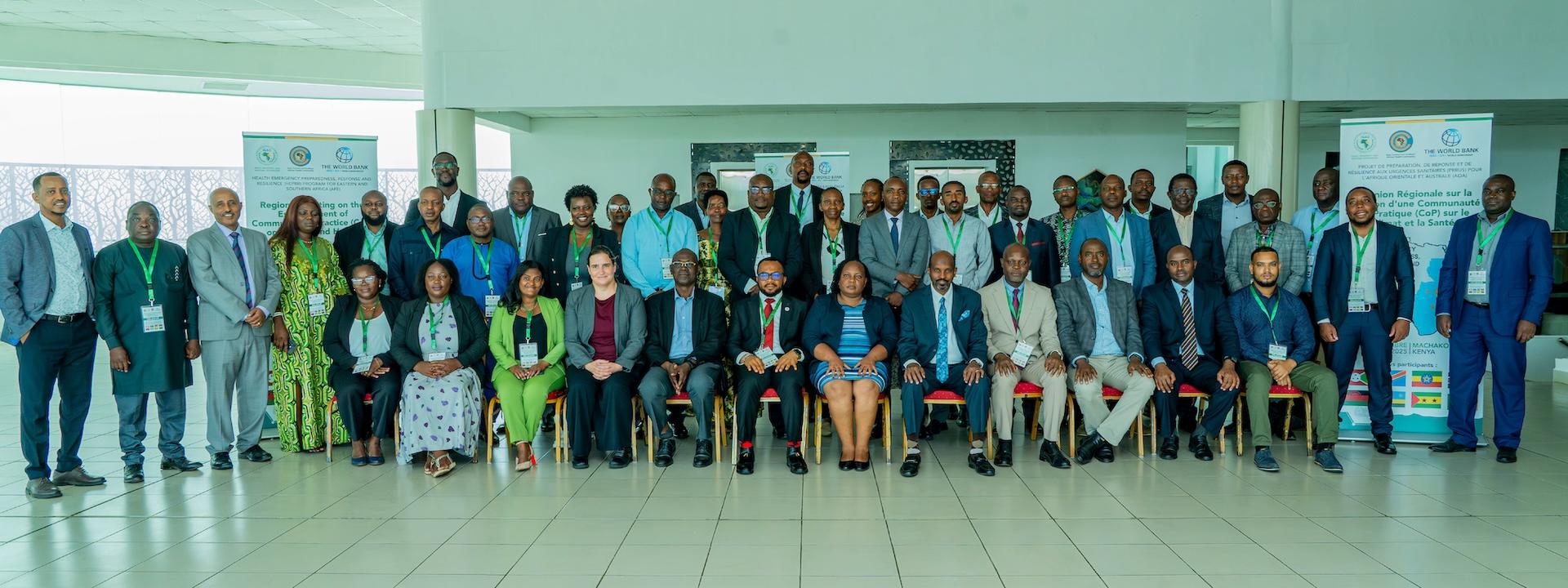
November 5, 2025 (Machakos, Kenya) The IGAD Secretariat successfully convened a meeting in Machakos, Kenya, to launch the Community of Practice (CoP) on Climate and Health under the Health Emergency Preparedness, Response and Resilience Program (HEPRRP) for Eastern and Southern Africa. The initiative underscores the region’s growing commitment to strengthening climate–health resilience.
The three-day meeting, held from 3rd to 5th November 2025, brought together representatives from HEPRRP participating countries, including Ethiopia, Kenya, Rwanda, Burundi, the Democratic Republic of Congo, Malawi, Zambia, Mozambique, and São Tomé & Príncipe.
Participants represented Ministries in charge of Health, Environment, and Climate, alongside experts from regional and international organizations such as Africa CDC, the World Bank, the World Health Organisation (WHO), and the East, Central, and Southern Africa Health Community (ECSA-HC).
Participants reviewed the impact of climate change on health systems in Eastern and Southern Africa, shared national experiences highlighting best practices, lessons learned, and ongoing national efforts to protect vulnerable populations.
In the presentations, countries demonstrated growing commitment for integration of climate shock preparedness into Health Emergency preparedness and response program and action toward integrating climate change adaptation into health systems, emphasizing the need for cross-sectoral collaboration, gender-responsive approaches, and knowledge sharing across institutions to strengthen resilience and guide collective action at national and regional levels.
The forum also endorsed the Terms of Reference (TOR) for the Community of Practice and outlined a road map for strengthening regional cooperation, knowledge sharing, and evidence-based policymaking in addressing climate–health challenges.
Representing the IGAD Executive Secretary, the Director, Health and Social Development, Amb. Moussa Meigague stressed that climate change was a growing driver of health risks in the region, noting how rising temperatures, changing rainfall patterns, and extreme weather events were intensifying disease outbreaks, food insecurity, and vulnerabilities among marginalized communities.
Amb. Meigague remarked that the CoP will enable countries to learn from each other’s experiences, promote evidence-based solutions, and strengthen collective regional capacity to address the growing climate-health challenges.
“Through this regional collaboration, we are laying the foundation for stronger, more adaptive, and more sustainable health systems that can effectively protect our populations against current and emerging threats,” said Meigague.
The Chief Guest, Dr. Kamene Kimenye, the Director General of the Kenya National Public Health Institute (NPHI), highlighted that the establishment of a Community of Practice on Climate and Health comes at a critical moment when countries in the region are already facing the visible consequences of climate change. She noted that climate variability was driving a resurgence of diseases, disruption of livelihoods and health systems with impacts across borders.
Dr. Kimenye emphasized the need to move away from reactive outbreak response and instead invest in preparedness, early warning systems, and resilient health infrastructure.
“Countries share climate risks, populations, and vulnerabilities, making coordinated regional action essential.”
Under the Health Emergency Preparedness Response and Resilience – Multi Phase Programmatic Approach (MPA) Program, the IGAD Secretariat is leading the climate and health nexus component, focusing on integrating climate information into early warning systems, advancing cross-border research, and promoting anticipatory action to reduce health risks.
Dr. Delphin Antwisi, representing the Chair of the Community of Practice – the Democratic Republic of the Congo underscored that the COP offers a vital platform to consolidate expertise, harmonize strategies, and jointly strengthen climate-resilient health systems. Dr. Delphine called for cross-border collaboration given the transboundary nature of climate risks. “We must share our experiences and pool our resources to build collective resilience,” said Dr. Delphine.
Participating countries developed priority themes and work plans for climate and health interventions at national level. In his presentation on “The Impact of Climate Change on Health System Resilience in Africa,” Dr. Mpairwe Allan from the World Health Organization’s Regional Office for Africa said climate change directly threatens the functioning and resilience of health systems, making them more vulnerable, especially across the continent.
Giving examples, Dr. Allan noted that warmer temperatures have led to a resurgence of malaria in highland areas, rising sea levels and flooding are fueling outbreaks of cholera and leptospirosis while air pollution is worsening respiratory conditions such as asthma and COPD. He emphasized that partnership and coordination across sectors and institutions will be essential in strengthening resilience to climate-related health risks across Eastern and Southern Africa.
Following the launch of the HEPRR – MPA Programme in May 2024, the 1st Regional Advisory Committee (RAC) endorsed the establishment of a Community of Practice (CoP) for Climate and Health. From 5th to 7th November, 2024, in Nairobi, Kenya, IGAD convened a consultative meeting of the HEPRR – MPA countries to identify priorities for addressing the climate change and Health nexus, which set the pace for the launch of the COP.
Dr Peter Okwero, the World Bank’s Task Team Lead highlighted that the Bank’s ongoing support was designed to combine national-level implementation with regional collaboration, recognizing that climate-related health challenges require coordinated systems and shared learning. Dr. Okwero reaffirmed the World Bank’s commitment to continue working closely with national teams and regional partners, while encouraging collaboration with Africa CDC, WHO among other partners.