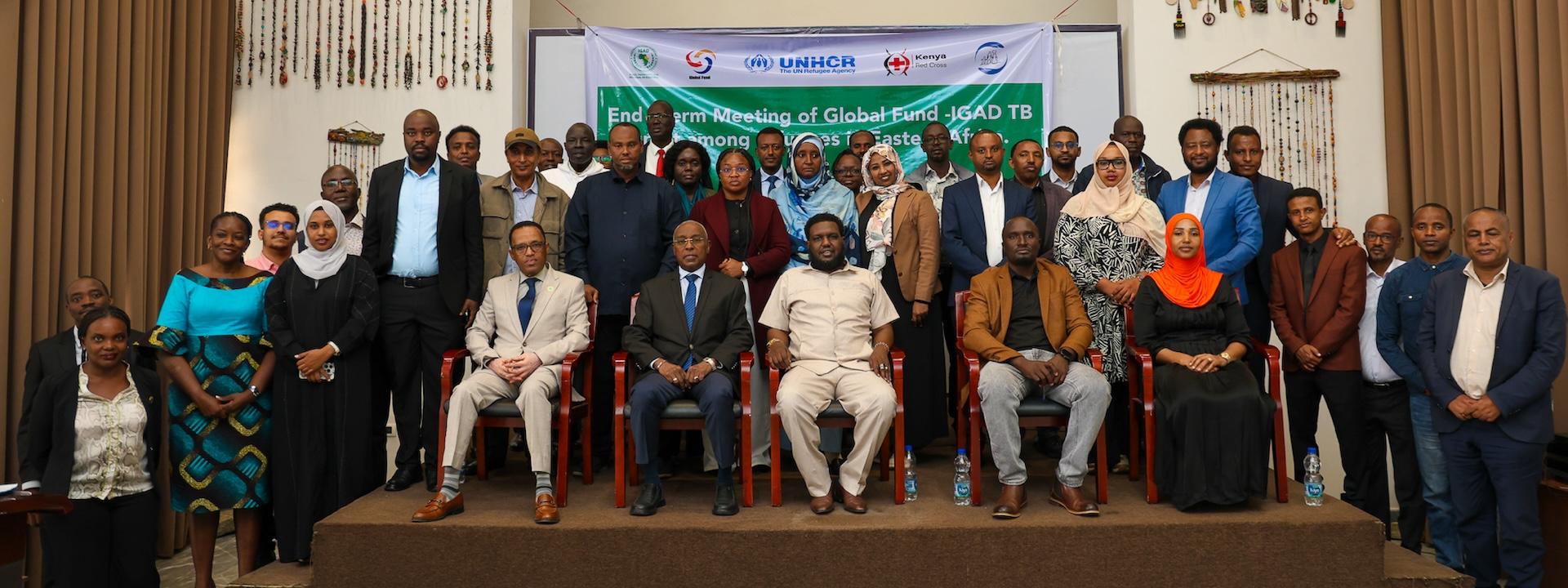
September 30, 2025 (Bishoftu, Ethiopia): The Intergovernmental Authority on Development (IGAD), in collaboration with UNHCR, the Kenya Red Cross Society (KRCS), and the Refugee and Returnee Service (RRS) of Ethiopia, convened the closure meeting of the Global Fund–supported TB/HIV grants in refugee camps and settlements across the region.
Since 2016, IGAD and its partners have implemented three consecutive Global Fund grants that transformed health service delivery in refugee settings. The interventions expanded access to HIV testing and counselling, improved availability of Anti-Retroviral Treatment (ART), introduced advanced TB diagnostics such as GeneXpert and FLM machines, rehabilitated health facilities, built the capacity of health and community health workers, and strengthened community-based outreach programmes.
The final continuation grant, valued at USD 6.43 million and implemented from April 2022 to March 2025, focused on TB and MDR-TB diagnosis, enhanced TB/HIV service delivery, and promoted cross-border collaboration among national TB and HIV programmes. The grant achieved an overall performance rate of 105% with an A1 rating, surpassing expectations.
Delivering remarks on behalf of IGAD Executive Secretary H.E. Dr. Workneh Gebeyehu, the Head of Mission to Ethiopia, Mr. Abebaw Bihiogen, praised the collective achievements and urged continued commitment:
“The successful completion of this grant is not the end of our journey, but a milestone in our shared commitment to protect the health and dignity of refugees and host communities. On behalf of H.E. Dr. Workneh Gebeyehu, I wish to commend the collective effort of our Member States and partners, whose collaboration has delivered tangible results. Our task now is to sustain these gains, strengthen cross-border cooperation, and ensure that no one is left behind in the fight against TB and HIV in our region.”
Country Reflections and Testimonies
The second day of the meeting highlighted experiences from Member States. In Djibouti, the Ministry of Health, working closely with UNHCR, successfully led implementation and ensured that monitoring and supervision translated into tangible impact for refugees. In Sudan, despite the eruption of war in 2023, implementation in the eastern part of the country remained steady through the efforts of the Ministry of Health and UNHCR.
An emotional moment unfolded as the Sudanese delegation described how the war has halted project implementation and reversed years of progress in the fight against TB and HIV. They raised grave concerns that while the grant was designed to support refugees, the conflict has multiplied the crisis by fueling mass displacement, deepening funding and staffing shortages, and overwhelming fragile health systems. Rising malnutrition, poor sanitation, and preventable disease outbreaks were highlighted as compounding the TB and HIV burden. Their testimony served as a stark reminder that the human cost of conflict extends far beyond the battlefield, striking at the very heart of health and survival.
IGAD reaffirmed that even as the grant comes to a close, its commitment to the people of Sudan endures, pledging to continue working tirelessly with partners to support their pursuit of peace, resilience, and dignity.
Sustainability and Transition
Participants engaged in country-level group discussions to chart strategies for sustaining the gains of the past eight years. A central theme emerged: refugee health must be integrated into national health sector responses rather than treated as parallel programming. This transition will be achieved through policy alignment, resource mobilization, and strengthened regional cooperation.
Shared Reflections and Gratitude
Sub-recipients, Country Coordinating Mechanisms (CCMs), and implementing partners—IGAD, UNHCR, KRCS, and RRS—converged on one message: future collaborative efforts are indispensable. CCM representatives emphasized the importance of cross-border platforms to maintain integration beyond the lifespan of donor-funded projects. Uganda and South Sudan extended votes of thanks to the Global Fund, IGAD, and partners for their unwavering support.
Special recognition was given to colleagues who have been part of the journey since inception. Tributes were paid to Dr. Tsegay and Saida, whose dedication was described as integral to the programme’s success. Saida’s farewell words of thanks underscored the human connections that sustain IGAD’s work.
Concluding Note
From the ceremonial opening to the closing session, the meeting reinforced IGAD’s cross-border mandate and the vision that refugee health must be a core component of resilient national health systems.
This closure is not an end, but a transition—towards ownership, sustainability, and innovation. Together, IGAD and its partners have set a new benchmark for refugee health collaboration in Eastern Africa. The resounding message was clear: safeguarding the gains achieved requires long-term investment, government ownership, inclusive strategies, and deeper cross-border cooperation to ensure that no community is left behind.
— END —