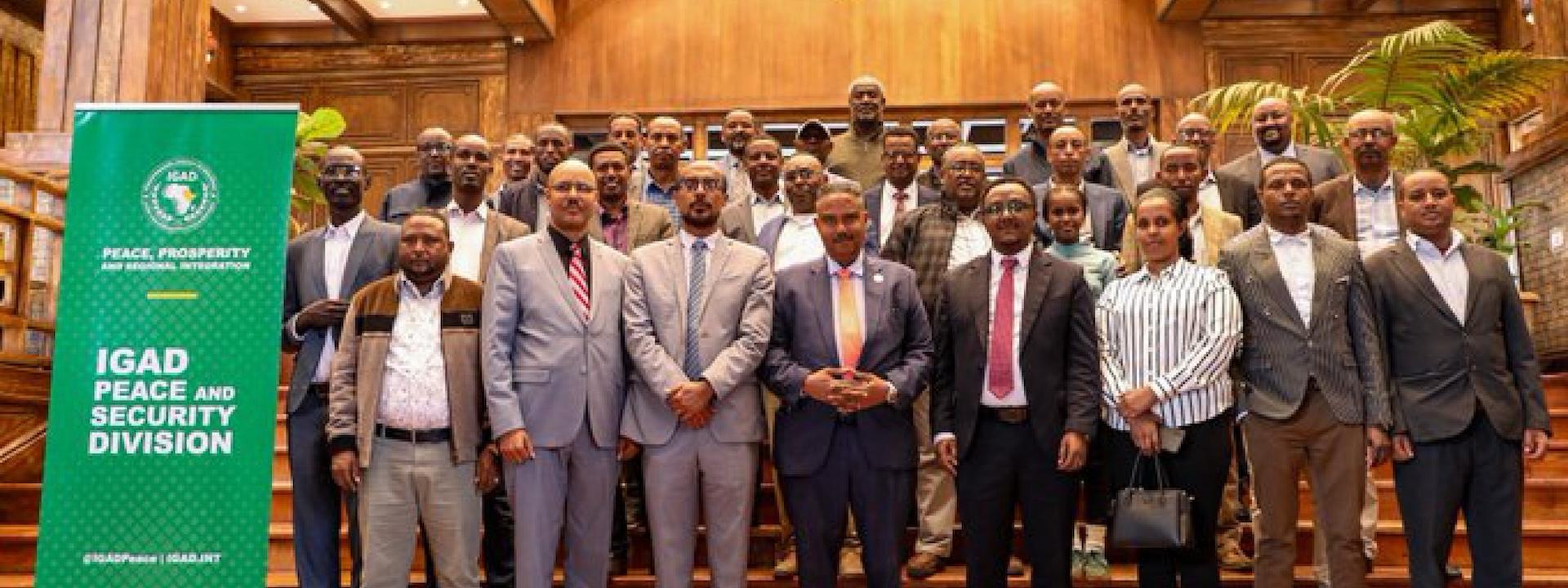
August 23, 2025 (Bishoftu, Ethiopia): the Peace and Security Division successfully concluded a three-day capacity-building training workshop on post-conflict transition. The workshop brought together senior officials and technical experts from federal and regional institutions of Ethiopia, alongside resource persons and IGAD staff, to strengthen knowledge and skills essential for post-conflict reconstruction and development (PCRD).
In his welcoming address, Commander Abebe Muluneh stressed IGAD’s continued commitment to supporting Member States in navigating fragile transitions. He highlighted the importance of strengthening institutions, addressing the root causes of conflict, and building social cohesion. “Efforts to transform conflict-habituated systems into peace systems are essential,” he noted, calling for inclusive dialogue and partnerships that can anchor long-term stability in the Horn of Africa. Ethiopian officials, including H.E. Temesgen Tilahun, Commissioner of the National Rehabilitation Commission, and H.E. Cherugeta Genene, State Minister at the Ministry of Peace, reaffirmed their government’s resolve to advance post-conflict peacebuilding measures, with IGAD and the African Union playing a central role in providing regional support.
The IGAD region continues to face complex conflict dynamics, marked by internal armed confrontations, cross-border tensions, humanitarian crises, and the world’s largest population of internally displaced people. With most Member States either still in conflict or transitioning from it, the demand for robust post-conflict reconstruction frameworks is pressing. In line with its Peace and Security Strategy, IGAD has been implementing the Post-Conflict Reconstruction and Development (PCRD) Policy Framework, designed to prevent relapse into violence, consolidate peace, and lay the foundations for sustainable development. Ethiopia, which has recently undertaken critical post-conflict initiatives, including the establishment of the National Rehabilitation Commission and the drafting of a Transitional Justice Policy, was identified as a priority beneficiary of capacity support.
The training workshop aimed to: Familiarise participants with the AU and IGAD PCRD policy frameworks, provide a conceptual grounding in conflict prevention, management, and resolution, as well as security governance and transitional justice, reflect on the Ethiopian context, identifying entry points for effective implementation of PCRD policies and processes. The three-day programme was structured around interactive presentations, group work, and plenary discussions.
Day 1: The workshop opened with remarks by Commander Abebe Muluneh, Director of the IGAD Peace and Security Division, alongside senior Ethiopian government officials. Participants were introduced to the IGAD and AU PCRD frameworks, followed by in-depth sessions on conflict prevention, management, and resolution.
Day 2: Delegates engaged in practical group work on conflict analysis and explored tools and strategies for peacebuilding. Discussions also covered security sector reform, disarmament, demobilisation, and reintegration (DDR), highlighting regional lessons and challenges.
Day 3: The final day focused on transitional justice, combining theoretical approaches with reflections on Ethiopia’s emerging policy framework. Deliberations underscored the importance of reconciliation, accountability, and inclusive governance in sustaining peace.
The workshop concluded with closing remarks from Maj. Gen. Habtamu Tilahun, Head of IGAD’s PCRD Unit, who emphasised the critical role of knowledge-sharing and capacity development in sustaining peace. He thanked the Government of Ethiopia for hosting the workshop and the participants for their dedication and meaningful participation. The successful completion of this workshop marks another stride in IGAD’s efforts to consolidate peace and stability in the region. By equipping practitioners with the tools to navigate complex post-conflict transitions, IGAD continues to support regional solutions for sustainable peace and development.
This workshop was funded by the European Union, through the APSA IV Programme.