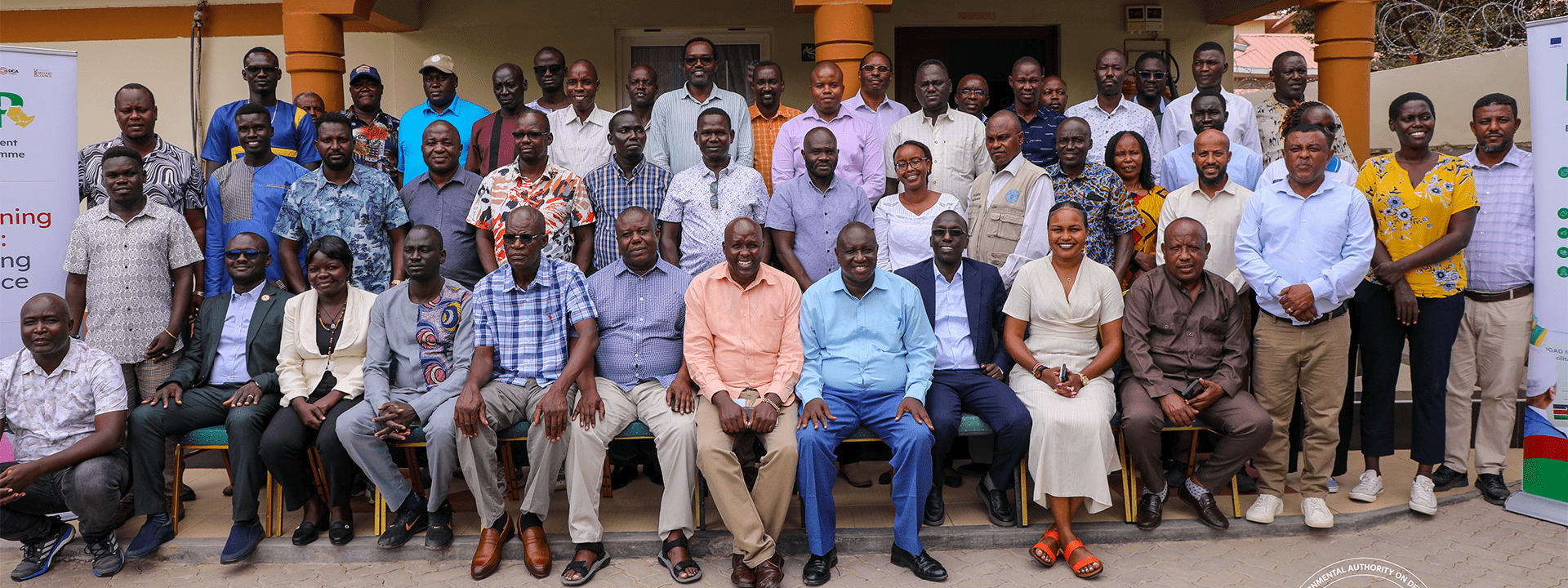
August 4-5, 2025 (LODWAR, Kenya): IGAD convened the Karamoja Cluster Baseline Validation Workshop under the Peaceful and Resilient Borderlands Programme (PRBP), bringing together national officials, community leaders, cluster coordinators, NGOs the European Union, GIZ, and IGAD’s specialised institutions—CEWARN, ICPAC, and ICPALD. The programme aims to reduce the impact of local conflicts and disasters in cross-border areas by reinforcing coordination, improving information-sharing, strengthening management of transboundary resources and establishing practical steering and learning mechanisms across IGAD clusters. The two-day meeting advanced a shared approach to resilience and coordination across the Karamoja cluster, which spans the borderlands of Kenya, Uganda, South Sudan, and Ethiopia.
The Karamoja cluster faces interlinked pressures: resource-based conflict, climate shocks, marginalisation, and weak cross-border governance. The PRBP funded by the EU and co-implemented by IGAD and GIZ, seeks to address these through coordinated, data-driven action at cluster-level. Validating a reliable baseline is essential to align strategies, refine indicators, and guide targeted interventions.
Participants included officials from IGAD Secretariat, CEWARN, ICPAC, ICPALD, GIZ and EU, alongside local governments, community representatives, cluster coordinators, NGOs and regional experts. The agenda also made space for inputs from IGAD specialised institutions and development partners.
The baseline work and agenda discussions pointed to priority actions the coordination structure can take forward: regular tier-one cross-border meetings; community engagement platforms; sectoral working groups; and functional data-sharing systems for timely decision-making. On transboundary resources, recommendations included institutional strengthening, community participation, and joint monitoring to address pressures on grazing, water, and range lands.
The workshop also took stock of existing and emerging coordination arrangements. While ad-hoc forums existed prior to PRBP, partners have since outlined a three-tier structure to knit together government, civil society and specialised institutions across the borderlands—a foundation the Karamoja cluster can now apply and adapt.
In closing, Hon. John Munyes Kiyonga, Peace Envoy for the Ateker Region, and Dr. Feto Esimo, IDDRSI Platform Coordinator, underscored the need for an inclusive, coordinated approach to reduce cross-border conflict and build resilience across the cluster. (Hon. John Munyes is also referenced among Karamoja stakeholders engaged during the baseline process.)
During the PRBP implementation, the cluster will use the validated baseline to guide joint action in conflict mitigation, climate resilience and socio-economic development; working with local authorities and communities, IGAD specialised institutions, and partners including GIZ and the EU.