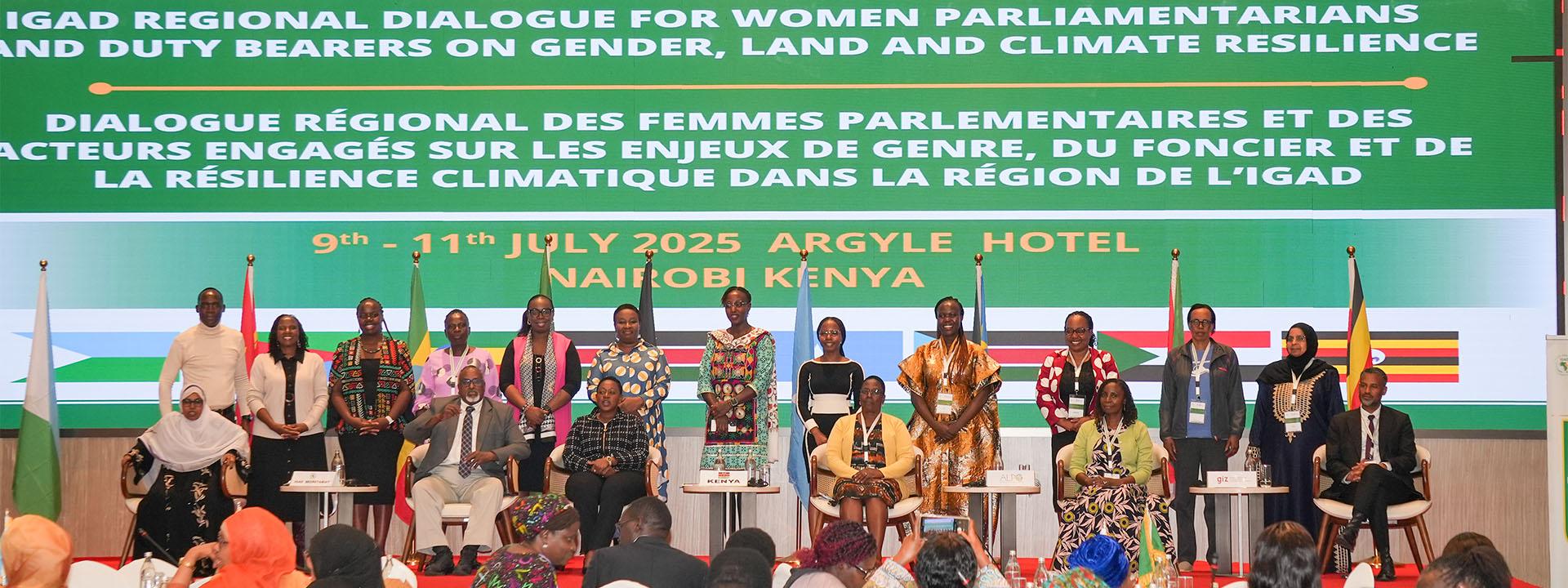
July 9–11, 2025 (Machakos, Kenya): The Intergovernmental Authority on Development (IGAD) has concluded a landmark Regional Dialogue that brought together women parliamentarians, land governance experts, policymakers, Civil Society Organization, UN agencies and development partners from across the region to advance gender equality in land rights and climate resilience. Grassroots women representatives were also at the fore.
The three-day forum was convened by IGAD’s Land Governance Unit with support from GIZ. It marked the culmination of national consultations held in six IGAD Member States (Djibouti, Ethiopia, Kenya, Somalia, South Sudan, and Uganda) and represented a significant step forward in regional efforts to integrate gender considerations into land and climate policies and actions.
“This Dialogue represents a pivotal step towards advancing regional commitments to gender equality and climate resilience,” said H.E. Mohamed Abdi Ware, IGAD Deputy Executive Secretary. “When women thrive, societies flourish. But for too long, historical discrimination has denied women access to land and leadership despite their frontline role in confronting climate change. The transformation we need is possible. We’ve seen it in Cameroon, where women are leading forest governance and climate action. Imagine the impact when we replicate this across the IGAD region.”
Across the region, women are central to agriculture, food security, and natural resource management. Yet, their contributions are frequently undermined by limited land ownership, weak legal protections, and exclusion from decision-making processes. The Dialogue provided a collaborative platform to address these inequalities through knowledge sharing, policy dialogue, and co-creation of actionable solutions.
“When we speak of land, we speak of power. Ensuring women have secure access to land is non-negotiable if we are serious about sustainable development,” said Hon. Gladys J. Boss, MGH, MP, Deputy Speaker of Kenya’s National Assembly. “While Kenya has made commendable progress in reforming laws and policies on gender and land, implementation continues to lag—hindered by deep-rooted patriarchal norms and inadequate enforcement. Across the IGAD region, women remain marginalised in land ownership, despite being the backbone of agriculture and natural resource management. Until we dismantle these structural barriers, true gender equality and climate resilience will remain out of reach.”
Hon. Irene Makaya, Chairperson of the Regional Development Committee, speaking on behalf of the Deputy Speaker, urged participants to stay the course: “The future we envision where every woman in our region can claim her rightful place as a steward of the land and a leader in climate resilience begins with the commitments you make today and the actions you take tomorrow.”
Throughout the event, participants engaged in expert panels, group discussions, and partnership-building sessions. Development partners and UN agencies including the International Land Coalition (ILC), African Development Bank (AfDB), GIZ, FAO, African Land Policy Center (ALPC), and UN Women shared experiences and pledged continued support.
The Dialogue concluded with two major outcomes: the establishment of the Regional Platform for Women Parliamentarians on Land Rights and Climate Resilience, and the launch of a comprehensive regional policy brief. Together, these initiatives form both a blueprint and a mechanism for sustained political advocacy and practical implementation.
As the curtain falls on the Machakos Dialogue, IGAD and its partners move forward with renewed purpose and collective resolve. As the proverb reminds us, “When spiderwebs unite, they can tie up a lion.” With strong leadership and regional solidarity, the IGAD region stands poised to advance inclusive, equitable, and climate-resilient land governance.